The brand people see is the tip. Beneath it sits all your organisation has ever published, and AI reads the whole of it. Your AI future is being built on that layer.
FT Longitude and Storyblok, 2026
“Survey of 550 senior executives of billion-dollar-plus companies reveals a potent and often invisible brake on AI’s benefits. It’s eroding annual revenues by millions and costing hundreds of avoidable labor hours per week.”1
01What lies beneath the brand.
Over 20 years an organisation publishes far more than it keeps in view. Reports are superseded, campaigns end, products change, people move on, and what they published stays where it was put. People reach the current version. AI reads them all, and treats each as true today.
Annual report
Superseded, still indexed. Last year’s figures answer as this year’s.
Microsite
Retired in name only. Its claims are still the organisation’s claims.
Press release
Figures restated since. The first version is the one AI finds.
Price list PDF
Several versions live. AI picks one, and it may not be yours.
Careers pages
Roles long filled. Candidates are told about benefits no longer offered.
Staging copy
Publicly served. Drafts read as the company’s final word.
02What it is already costing you.
The layer beneath the brand carries a bill, and it is being paid now. Executives of billion-dollar-plus companies put 5.9% of annual revenue down to poor, unclear or outdated content, an average of $658.6 million a company, and spend a further $4.8 million a year fixing it. Across the companies surveyed that is a content-debt burden of $4.63 trillion a year, larger than the economy of Japan.9
The bill is paid in people as well as money: a third of the content budget and 105 hours a week go on auditing, correcting and retiring what is already published. Spending more does not bring it down. The companies spending most on fixing report the most revenue affected; the ones least affected are those that can see all they have published and put resource where the hidden risk is greatest.
The executives know it. What most of them lack is a view of the layer itself: which pages and documents are shaping what AI says, and which of them to deal with first.
03What AI makes of it.
AI weighs neither age nor intent. It reads what it can reach, trusts a well-structured old page over a thin new one, and gives a PDF up to 1.8 times the authority of the same words on a web page.2 The result is a view of your organisation assembled from material you stopped looking at, and it is the view the customer, the investor and the regulator now meet first.
The measure
Most of what AI gets wrong about you began with something you published.
79% of misinformation or misrepresentation has the organisation’s own online position as its root cause.3 Because the cause is yours, it can be addressed once it is known.
AAAnow Research, Dec. 2023 to Jan. 2026; P&C (human misinformation) 2014 to 2023.
Fit for AI visibility means what AI reads of you matches what you know of yourself. That is the first of the 2 questions the Gap Analysis answers.
04What it does to the AI you are building.
Each AI project, inside the organisation or in front of it, draws on the same layer. Where that layer is out of date or contradicts itself, the project inherits the contradiction: outputs that disagree, pilots that stall, and a failure recorded against the technology rather than the material beneath it.
Promoting AI visibility before you know what AI reads makes it worse. One organisation changed a product, found AI still telling customers the old position, and bought a visibility programme. The programme promoted the position AI had already formed, and the wrong answer grew louder.4
The order of the work
Know what AI sees of you first. Then promote what you want it to see.
05How far it has drifted.
The drift can be measured. Placed on the AI Readiness Maturity Scale™, a regulated sector shows 4% of organisations refusing the AI connection altogether and 83% in ACT, where AI struggles to read or ignores their content. Only 3% hold the strongest position, MONITOR.5
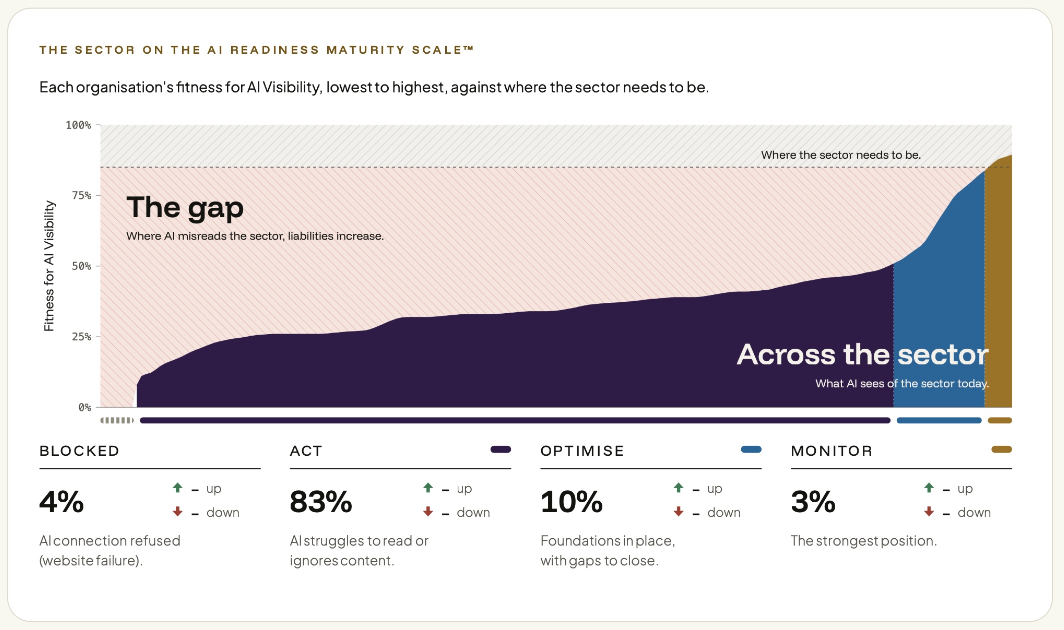
The shaded area is the gap between where the sector stands and where it needs to be, and where AI misreads a sector, liabilities increase. By the odds, your organisation is among the 87%, and nothing inside the organisation will tell you so.
06Who carries it.
What has been left unmanaged costs money to carry and brings regulatory risk with it. A tribunal and a court have held companies to what their own chatbots said.7 Directors owe reasonable care, skill and diligence; boards declare the effectiveness of their material controls; insurers now ask for governance evidence at renewal.
The measure
The concern has reached the top of the organisation.
57% of leaders name AI errors and misinformation the leading threat to AI adoption.6 What a board lacks is the answer for its own organisation, with the evidence behind it.
Gallagher, The 2026 AI Adoption and Risk Benchmarking survey.
Are directors and officers increasingly exposed as AI grows? Yes. Unnecessarily? Yes, because the material is the organisation’s own. Evidence that the business has looked, and acted, is what mitigates it. That is the second question.
07Where you stand.
The Gap Analysis measures the gap: what AI reads of your organisation, set against what you know of yourselves. It shows how far the 2 have drifted, which pages and documents are causing it, and what to deal with first. The 5 teams concerned, marketing, digital, legal, risk and compliance, agree those priorities together, so the work that follows is not reopened.
Where we stand
How fit each website is for AI visibility, on the AI Readiness Maturity Scale™.
What is causing it
The pages and documents shaping what AI says of you.
What first
The priorities, in the order of the difference they make.
What cannot change
What is outside your control, so it is not worked on.
Written down
Where you stand, with the evidence, for the board, the investor, the insurer and the regulator.
08What follows.
Addressing what the Gap Analysis shows removes cost as well as risk, and automation does most of the work. AI Accelerator makes the changes in 6 weeks, and AI Confidence brings diligence and oversight as the organisation advances and grows. Your attention moves to the AI advantage.
Next
Know how far it has drifted, before more is built on it.
Commonly asked questions.
You are spending on AI. Do you know what AI reads of you?
Of marketing decision-makers, 82% now fund AI visibility and 94% of enterprise digital leaders plan to increase it, yet only 16% of brands systematically track what AI sees of them. The spend rests on what AI reads of your organisation, and in most cases nobody has been asked to check it.
Why is so little of it coming back?
Of integrated enterprise generative AI pilots, 5% were extracting millions in value; the rest showed no measurable return. The failures are written up as AI failures, and the material the AI was reading is rarely examined. Visibility spend promotes whatever AI already reads, faults included.
What is AI reading in your name?
Over 20 years of publishing: superseded pages, retired microsites, PDFs in several versions, partner copies and articles by people who have left. Of websites profiled, 41% were unknown to the organisation’s own digital teams, and more than 6 in 10 executives cannot see all of their published content. AI reads it all and serves it as current.
How wide is the gap, and is it ours?
In a regulated sector placed on the AI Readiness Maturity Scale™, 4% refuse the AI connection and 83% sit in ACT, where AI struggles to read or ignores their content; 3% hold MONITOR. By the odds, your organisation is among the 87%, and from inside there is nothing to show it.
What is it already costing us?
Executives put 5.9% of annual revenue down to poor, unclear or outdated content, spend 34% of the content budget fixing it and 105 hours a week maintaining it. Spending more does not help; the organisations least affected are the ones that can see all they have published and put resource where the hidden risk is greatest.
Are our directors and officers exposed by it?
Increasingly, yes: 57% of leaders name AI errors and misinformation the leading threat to AI adoption, 69% call the lack of content visibility a compliance risk, and a tribunal and a court have held companies to what their own chatbots said. Unnecessarily, because the material is your own. Evidence that the business looked, and acted, is what mitigates it.
Why has nobody inside raised it?
From inside, the organisation looks right: the site loads, search indexes it, the pages people check read correctly, and visibility reporting measures what AI says, not what AI can reach. One organisation spent £350,000 to be seen by AI routes its own website was turning away, and a year of monthly reporting showed nothing. The gap is only seen from outside, as AI sees it.
Why now, and not after the next AI project?
Each time AI answers, it reinforces the material it answered from, and a position left standing hardens. Correcting it later means reversing what the market has already been told, slower and dearer than setting it right first. The check sits before the spend.
What does the Gap Analysis give us?
The gap measured across your primary website and up to 4 further sites: where you stand on the AI Readiness Maturity Scale™, what is causing it, what to deal with first and what cannot change, agreed by the 5 teams concerned. It takes 3 weeks and your people’s time goes on 2 sessions. The changes are made in AI Accelerator.
Why AAAnow?
We have read organisations from the outside for 25 years, across more than 119 million websites, and have analysed how AI reads website content and PDFs since 2023. The sector benchmarks on this site are that reading, published. The Gap Analysis is the same reading, run for your organisation alone and held for your board.
09Sources.
- FT Longitude and Storyblok, Content Debt: A $4.63 Trillion Business Liability2026. Survey of 550 senior executives at companies with annual revenue of $1 billion or more, across Australia, Germany, the Netherlands, the UK and the US. Quotation from the executive summary, reproduced as published.
- AAAnow Research, PDF authorityAI systems gave a PDF up to 1.8 times the authority of the same content as a web page.
- AAAnow Research, the 79%79% of misinformation or misrepresentation has the organisation’s own online position as its root cause. AAAnow Research, Dec. 2023 to Jan. 2026; P&C (human misinformation) 2014 to 2023.
- AAAnow Use Case Library, use case 37The product announcement published and missed, and the visibility programme that entrenched the old position. Observed pattern, narrative illustrative, no brand identified.
- AAAnow, the sector on the AI Readiness Maturity Scale™Sector benchmark chart as published on this page: BLOCKED 4%, ACT 83%, OPTIMISE 10%, MONITOR 3%.
- Gallagher, the 57%The 2026 AI Adoption and Risk Benchmarking survey: 57% name AI errors and misinformation the top concern threatening AI adoption.
- Where the liability sitsMoffatt v Air Canada, 2024 BCCRT 149, British Columbia Civil Resolution Tribunal, 14 Feb. 2024. Verbraucherzentrale Nordrhein-Westfalen e.V. v Aesthetify GmbH, Higher Regional Court of Hamm, 12 May 2026, I-4 UKl 3/25, not final. UK Companies Act 2006, section 174. UK Corporate Governance Code, Provision 29. Aon, AI risk 2026: a practical agenda, on D&O underwriting interest in governance evidence.
- The spend into AI, and its measurementFractl, AI visibility budget survey, 21 Jul. 2026, 343 US marketing decision-makers: 82% allocate budget to AI visibility. Conductor, 2026 CMO Investment Report, 250+ enterprise digital leaders: 94% plan to increase it. IAB, AI visibility measurement framework, Aug. 2026: 16% of brands systematically track AI visibility. MIT NANDA, The GenAI Divide: State of AI in Business 2025: 5% of integrated enterprise GenAI pilots were extracting millions in value.
- FT Longitude and Storyblok, the figuresContent-debt burden of $4.63 trillion a year across 6,138 billion-dollar-plus companies; $658.6 million of revenue affected and $4.8 million spent fixing content per company; figure 2, share of revenue affected by country: Netherlands 6.5%, Germany 6.0%, UK 5.8%, US 5.7%, Australia 5.4%; 91% say well-maintained content will matter more over the next 2 years; 67% say poor content quality or structure reduces visibility in search and AI; 5.9% of annual revenue affected by poor, unclear or outdated content; 34% of content budget spent addressing it; 105 hours a week maintaining content; more than 6 in 10 without clear visibility of all published content; 69% say that lack is a compliance risk.
- P&C / Sitemorse risk profiling, the 41%Of the websites profiled, 41% were unknown to the organisations’ own digital teams. P&C / Sitemorse risk profiling, 2017 to 2023, covering more than 119 million websites.
- AAAnow Use Case Library, use case 30£350,000 spent to be seen by AI through routes the estate was turning away. Observed, anonymised.