01The spend went in, and the wrong answer got louder.
A consumer brand changed a product, announced the change, and found AI still telling its customers the old position. It read that as a visibility problem and bought a programme of content, promotion and AI visibility work. The programme promoted the product story the machines had already assembled from the old material, so the wrong position was now better promoted than before.
The cause was the page the announcement sat on. Nobody had examined it, because the announcement was visibly there and the page worked for the people who checked it.
The money is moving quickly in one direction. Fractl’s Jul. 2026 survey of 343 US marketing decision-makers puts 24% of search and content budgets into AI visibility, with 82% allocating something to it. Conductor’s 2026 survey of 250+ enterprise digital leaders finds 94% planning to increase that investment this year. Typeface’s report of 14 Oct. 2026, from 500+ US and UK marketing leaders, finds 49% planning to deprioritise or stop traditional SEO as AI discovery rises.
The ambition behind the spend is sound. Among consumers, 58% now start their search with AI, and 94% of business buyers use AI in their buying process. The spend follows them, and the question is what it amplifies when it lands.
02What visibility amplifies.
Visibility surfaces what the organisation has already built. It promotes whatever AI can read, in the state AI finds it, and it promotes the faults with the same energy as the strengths.
For most people asking, AI’s answer is the only version of the organisation they meet. Where that answer is assembled from a superseded page, the promotion that follows makes the superseded page the version more people meet.
AAAnow’s research finds that 79% of misinformation or misrepresentation has the organisation’s own online position as its root cause. AAAnow Research, Dec. 2023 to Jan. 2026; P&C (human misinformation) 2014 to 2023. The source is the material the organisation itself put online over years and stopped looking at: superseded pages, duplicate PDFs, partner copies, archived campaigns, the announcement buried in a heavy page. Promotion leaves that material as it is and puts it in front of more people.
The order of the work decides the outcome. Fundamentals come first: what AI can find, read, interpret and act on across the digital landscape. Governance comes next: ownership, review cadence and authority for change, so the information stays correct as AI keeps reading it. Visibility comes last, once the organisation knows what it is amplifying. Reverse that order and the effort lands in the wrong place, promoting material the foundations cannot yet support.
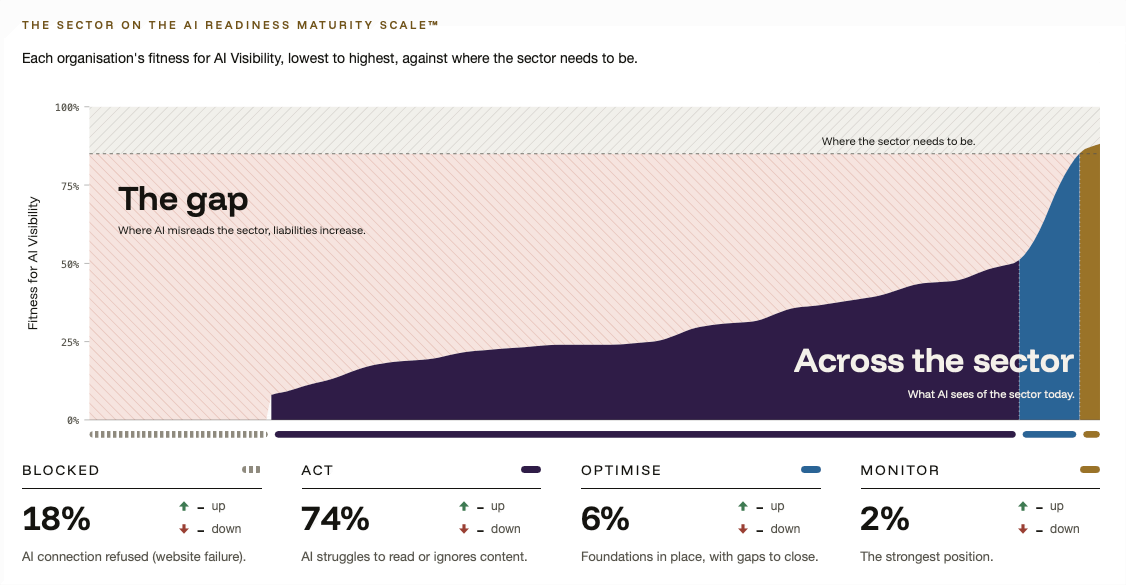
The chart places a sector on the AI Readiness Maturity Scale™, each organisation’s fitness for AI visibility from lowest to highest, against where the sector needs to be. In this sector, 18% sit in BLOCKED, where the AI connection is refused; 74% sit in ACT, where AI struggles to read or ignores content; 6% sit in OPTIMISE, with foundations in place and gaps to close; and 2% sit in MONITOR, the strongest position.
The shaded area between the curve and the line is the gap, where AI misreads the sector and liabilities increase. Visibility spend applied across this sector today promotes, for 92% of it, a position AI cannot read properly.
03What that looks like in practice.
One organisation spent £350,000 to be seen by AI through routes its own estate was turning away. The spend went on visibility for foundations that could not be read.
A financial institution ran a joint promotion on a partner site 2 years earlier, for products no longer applicable to that market. No central record of the shared positioning existed. AI surfaced the partner page as current product information, and a regulatory inspection followed, citing misrepresentation of products to a market the firm could no longer serve.
A consumer brand withdraws a product claim after a complaint. The claim survives on a regional site, in a campaign archive and in a third-party repository. AI repeats it as the brand’s current position, and a competitor’s dispute finds it first, where it reads as an admission.
External research from Oct. 2026 shows the same mechanism at market scale. BeSeenByAI audited 1,101 pricing pages and found 32.8% showed no visible price to an automated reader. On 136 sites with no readable price, 78.5% of AI answers stated a price anyway. Where answers could be compared, 39.2% of sites were given different prices by different assistants. Where the price was clearly visible, disagreement between the assistants fell by a factor of 6. A machine that cannot read the number supplies one from somewhere else.
Typeface’s Oct. 2026 report describes what the race is doing to the material itself. Of the marketing leaders surveyed, 62% say brands are trading content quality for AI citations. In the same sample, 68% say they are creating content for AI that people are not expected to see, and 26% are building internal or hidden pages to influence how AI describes them. A further 42% say they are actively keeping their brand consistent across the third-party content AI draws from, and 25% name wider visibility for negative opinions and third-party content as the biggest risk in the work. That is the amplification question, asked from the other side.
04The race, and what running it faster costs.
The pressure is to do more, do it faster, and be seen before the competitor is. The race is being run without the instruments to see where anyone stands.
In the Typeface sample, 50% of leaders make their best guess at which prompts customers type, and measurement and optimisation is the most cited barrier to scaling AI-powered content, at 27%. The IAB’s Aug. 2026 measurement framework found 16% of brands systematically track AI visibility, while more than 20 vendors sell tools that disagree over the same brand. Adobe’s Apr. 2026 research among 500+ marketers found 98% lacked a documented AI optimisation roadmap and full confidence in their approach.
Most of the picture being promoted belongs to someone else. McKinsey finds brand-owned sites supply 5 to 10% of the sources AI search references. AirOps, across 21,000+ brands, finds 85% of brand mentions in AI search come from third-party content. Risk profiling finds 41% of websites are unknown to the organisation’s own digital teams. P&C / Sitemorse risk profiling, 2017 to 2023, covering more than 119 million websites. The race accelerates a picture assembled largely from material the organisation does not own and does not know it still has online.
The picture compounds with each use. Each retrieval reinforces the material retrieved, and each reinforcement makes the picture harder to displace. Competitors read accurately first become the basis of the comparison the market uses, and the organisation arriving later is correcting a picture already in circulation. Promotion applied to the wrong picture sets it faster.
The people buying visibility acted on what they could see. The page looked right and the announcement was there, and nothing in front of them showed what the machine had extracted. That is a limitation of the view, and the view can now be changed.
Gallagher’s 2026 AI Adoption and Risk Benchmarking survey finds 57% of respondents name AI errors and misinformation as the top concern threatening AI adoption. The concern is already shared at the top of the organisation, and the check that answers it sits before the spend.
05Control is easier now than it was.
What was invisible is now measurable. An organisation can be read from the outside exactly as AI reads it, and the reading starts at the digital doorway. The doorway runs up to 24 agents, 4 people routes and 15 AI-related routes, each recording whether the route was served, challenged but retained, turned away, or met with no reply. It is measured live on the day and records the observed outcome only.
The doorway is the beginning of AI Readiness, and the reading continues from there. It shows what a machine extracts from each page, which older pages supply the position AI serves for each product, and where PDFs sit duplicated and untracked. The reading rests on 118m sites and 4.5m PDFs analysed, with 187 agents performing more than 360,000 checks, and it is repeated as the estate changes.
The work runs in 4 moves, in order. Understand the external AI footprint: what AI can reach today across owned content, historic assets, PDFs, archived information and third-party references. Confirm the fundamentals: whether that information is accurate, accessible, consistent, current and trustworthy. Establish governance: named ownership and accountability, so the information stays correct as AI keeps reading it. Build visibility, once the organisation understands the foundation it is amplifying.
Done in that order, the visibility spend amplifies a position the organisation can stand behind, and the 24% buys what it was meant to buy.
The question for the head of AI, the CEO and the CMO sits before the next invoice: are we fit for AI visibility, and what does that mean for us?
06Where the liability sits.
A tribunal and a court have now attributed a chatbot’s words to the company that ran it. In Moffatt v Air Canada, the British Columbia Civil Resolution Tribunal found the airline liable for negligent misrepresentation by the chatbot on its own website. It rejected the argument that the chatbot was a separate entity responsible for its own words. The correct policy sat on another page of the same site, and the tribunal saw no reason a customer should have to check one part of the website against another. An organisation is held to what its own channels say, including the parts that disagree with each other.
On 12 May 2026 the Higher Regional Court of Hamm ruled in Verbraucherzentrale Nordrhein-Westfalen v Aesthetify. False statements by a company’s AI chatbot are the company’s own commercial act under German unfair competition law, even where the chatbot was fed only correct data. The judgment is not final, with leave to appeal granted to the Federal Court of Justice. “The AI said it” has yet to be accepted as a defence.
Both cases concern a chatbot the company itself operated. An answer from an external AI system is not automatically the company’s statement, and the exposure turns on what the company published, what it knew, and what it did once it knew.
In the UK, directors owe their company reasonable care, skill and diligence under section 174 of the Companies Act 2006. A failure to address a known information risk can support a claim where that failure breaches the duty. Section 89 of the Financial Services Act 2012 makes it a criminal offence to knowingly or recklessly make a materially false or misleading statement to induce an investment decision. Provision 29 of the UK Corporate Governance Code asks the board to declare the effectiveness of its material controls, and the information the company has published, and AI reads, is among them. The FCA’s Consumer Duty, PRIN 2A.5, requires firms to support retail customers’ understanding of the products and services they are offered.
In the US, section 10(b) of the Securities Exchange Act and Rule 10b-5 expose an officer who knowingly makes materially false statements in connection with securities trading to personal liability, with private claims also requiring reliance and loss. Aon reports growing interest from D&O underwriters in governance evidence. In each jurisdiction the exposure follows the organisation’s own conduct and awareness, which is why the check before the spend is an act of governance.
Sources.
External sources
- Fractl · AI visibility budget survey21 Jul. 2026 · Survey of 343 US marketing decision-makers, reported by Digiday, 7 Aug. 2026. https://www.relevantaudience.com/geo/marketers-24-percent-search-budgets-ai-visibility/FractlWe do not enable external links - please copy and paste, you are then certain as to the link being opened
- Conductor · 2026 CMO Investment Report, The State of AEO/GEO2026 · Survey of 250+ enterprise digital leaders. https://emarketer.com/content/marketers-invest-more-geo-ai-visibility-becomes-top-priorityConductorWe do not enable external links - please copy and paste, you are then certain as to the link being opened
- Typeface · The Typeface Signal Report: The AI Visibility Gap14 Oct. 2026 · Survey of 500+ US and UK marketing leaders, reported in detail by PPC Land. https://ppc.land/49-of-marketers-plan-to-deprioritize-seo-typeface-survey-finds/TypefaceWe do not enable external links - please copy and paste, you are then certain as to the link being opened
- Harvard Business Review · Dubois, Dawson and Jaiswal, Forget What You Know About SEO. Here’s How to Optimize Your Brand for LLMsJun. 2025 · Reporting a 2025 survey of 12,000 consumers. https://hbr.org/2025/06/forget-what-you-know-about-seo-heres-how-to-optimize-your-brand-for-llmsHarvard Business ReviewWe do not enable external links - please copy and paste, you are then certain as to the link being opened
- BeSeenByAI · The Invisible Price TagOct. 2026 · 1,101 pricing pages and 136 AI-tested sites; vendor research, BeSeenByAI sells AI visibility services; reported by The News International, 14 Oct. 2026. https://www.thenews.com.pk/latest/1419872-your-ai-shopping-assistant-may-be-quoting-prices-stores-never-postedBeSeenByAIWe do not enable external links - please copy and paste, you are then certain as to the link being opened
- IAB · AI visibility measurement frameworkAug. 2026 · Reported by PPC Land. https://ppc.land/only-16-of-brands-track-ai-visibility-as-iab-sets-measurement-standard/IABWe do not enable external links - please copy and paste, you are then certain as to the link being opened
- Adobe · AI search readiness researchApr. 2026 · Research among 500+ marketers, reported by PPC Land. https://ppc.land/adobe-98-of-marketers-have-no-confident-ai-search-strategy/AdobeWe do not enable external links - please copy and paste, you are then certain as to the link being opened
- McKinsey & Company · New front door to the internet: Winning in the age of AI searchOct. 2025. https://www.mckinsey.com/capabilities/growth-marketing-and-sales/our-insights/new-front-door-to-the-internet-winning-in-the-age-of-ai-searchMcKinsey & CompanyWe do not enable external links - please copy and paste, you are then certain as to the link being opened
- AirOps · The influence of offsite signals in AI searchAnalysis of 21,000+ brands. https://www.airops.com/report/the-influence-of-offsite-signals-in-ai-searchAirOpsWe do not enable external links - please copy and paste, you are then certain as to the link being opened
- Gallagher · The 2026 AI Adoption and Risk Benchmarking survey2026 · AI errors and misinformation named as the top concern threatening AI adoption. https://www.ajg.com/news-and-insights/features/ai-adoption-and-risk-benchmarking-2026/GallagherWe do not enable external links - please copy and paste, you are then certain as to the link being opened
- Moffatt v Air Canada, 2024 BCCRT 149British Columbia Civil Resolution Tribunal, 14 Feb. 2024, summarised by Norton Rose Fulbright. https://www.fanews.co.za/article/legal-affairs/10/general/1120/company-is-liable-for-chatbot-miscommunications-holds-canadian-tribunal/38906Moffatt v Air CanadaWe do not enable external links - please copy and paste, you are then certain as to the link being opened
- Verbraucherzentrale Nordrhein-Westfalen e.V. v Aesthetify GmbHHigher Regional Court of Hamm, 12 May 2026, I-4 UKl 3/25, case summary by CMS. https://cms.law/en/gbr/publication/artificial-intelligence-and-copyright-case-tracker/germany-verbraucherzentrale-nordrhein-westfalen-e.v.v.-aesthetify-gmbh-12-may-2026Verbraucherzentrale NRW v AesthetifyWe do not enable external links - please copy and paste, you are then certain as to the link being opened
- UK Companies Act 2006, section 174Duty to exercise reasonable care, skill and diligence. https://www.legislation.gov.uk/ukpga/2006/46/section/174/data.htmlCompanies Act 2006, section 174We do not enable external links - please copy and paste, you are then certain as to the link being opened
- UK Financial Services Act 2012, section 89Misleading statements. https://www.legislation.gov.uk/ukpga/2012/21/section/89/data.htmlFinancial Services Act 2012, section 89We do not enable external links - please copy and paste, you are then certain as to the link being opened
- FRC · UK Corporate Governance Code, Provision 29Board declaration on the effectiveness of material controls. https://www.frc.org.uk/library/standards-codes-policy/corporate-governance/uk-corporate-governance-code/UK Corporate Governance CodeWe do not enable external links - please copy and paste, you are then certain as to the link being opened
- FCA Handbook · PRIN 2A.5, Consumer DutyConsumer understanding outcome. https://handbook.fca.org.uk/handbook/prin2a/prin2as5FCA Handbook, PRIN 2A.5We do not enable external links - please copy and paste, you are then certain as to the link being opened
- US Securities Exchange Act 1934, section 10(b), and SEC Rule 10b-5Personal liability for knowingly made materially false statements in connection with securities trading. https://www.law.cornell.edu/uscode/text/15/78jSecurities Exchange Act 1934, section 10(b)We do not enable external links - please copy and paste, you are then certain as to the link being opened https://www.law.cornell.edu/cfr/text/17/240.10b-5SEC Rule 10b-5We do not enable external links - please copy and paste, you are then certain as to the link being opened
- Aon · AI risk 2026: a practical agendaD&O underwriting interest in governance evidence. https://www.aon.com/en/insights/articles/ai-risk-2026-practical-agendaAonWe do not enable external links - please copy and paste, you are then certain as to the link being opened
AAAnow research and material
- AAAnow Research · Root cause of misinformation and misrepresentationThe organisation’s own online position is the root cause of 79% of misinformation or misrepresentation. AAAnow Research, Dec. 2023 to Jan. 2026; P&C (human misinformation) 2014 to 2023.
- P&C / Sitemorse risk profiling · Websites unknown to their own digital teamsOf the websites profiled, 41% are unknown to the organisation’s own digital teams. P&C / Sitemorse risk profiling, 2017 to 2023, covering more than 119 million websites.
- AAAnow · AI Readiness: What AI sees, not what the organisation saysVersion 1.5, Jun. 2026 · The AI Readiness framework, the order of fundamentals, governance and visibility, and the financial services partner-site case.
- AAAnow · Use Case LibraryUse case 37, the product announcement published and missed, and the visibility programme that entrenched the old position: observed pattern, narrative illustrative, no brand identified. Use case 30, £350,000 spent to be seen by AI through routes the estate was turning away: observed, anonymised. Use case 36, the withdrawn claim put back under the company’s name: illustrative scenario drawn from documented patterns. https://aaanow.ai/use-cases/ (opens in a new tab)
- AAAnow · The sector on the AI Readiness Maturity Scale™Chart as published with this article.
Further reading
- AAAnow · Benchmarking the Superbrands, including Apple, Barclays, Coke and the impact of 3% AI readinessCMSWire, 2026.
- AAAnow · Automation supporting AI Governance, starts outside-in.The article on the AAAnow site. https://aaanow.ai/articles/automation-supporting-ai-governance/ (opens in a new tab)
- AAAnow · AI Readiness? service pageThe AI Accelerator service page. https://aaanow.ai/service/ai-accelerator/ (opens in a new tab)