01A starting point, set out from the outside in.
For a risk manager, a Head of AI or a board, the first question is a simple one: where do we stand? Internal reports describe what the organisation intends to publish. AI reads what is actually there, across current sites, historic material and documents that may have been forgotten.
IN|SITE brings that outside-in reading together as a single position, and answers 2 questions with evidence: is the organisation fit for AI visibility, and are its directors and officers becoming increasingly, and unnecessarily, exposed as AI grows?
02The 3 levels of detail.
IN|SITE is the first of 3 levels of detail the Platform provides. Each level adds detail to the one before it.
- 01
IN|SITE
One-off, point in time
Where you start: AI readiness, misinformation exposure, and what AI can reach.
- 02
Ongoing
How the position moves over time, with significant change brought to attention.
- 03
Following on, for action
What to correct, in what order, why, and how to do it.
From there, OVER|SITE follows the position as it changes, and WORK|PACK turns it into the work to be done.
03What IN|SITE sets out.
AI Readiness
Where does the organisation stand?
The organisation’s position on the AI Readiness Maturity Scale™, from ACT through OPTIMISE to MONITOR.
Misinformation exposure
Where is AI likely to get it wrong?
The likely exposure to misinformation and misrepresentation, drawn from what the organisation has published.
The breakdown
Where does the position come from?
The position broken down by content infrastructure, web pages and PDF pages, so each part can be read on its own.
Digital Doorway
What can AI reach?
What AI can access, and where access is being prevented, drawn from Digital Doorway.
Read together, they measure the gap between what AI sees of the organisation today and what it understands of itself: the gap where misinformation forms.
04What a result looks like.
The example below is from a result for Northvale Airways, an illustrative airline: the headline first, then the 3 readings behind it, then whether AI can reach the organisation at all.
Results · Northvale Airways
1 in 6 AI answers about Northvale Airways are likely to be incorrect or misleading.
That is the account travellers, the AI agents acting for them, investors and regulators receive before they speak to you.
01 · The headline
How often AI is likely to be wrong.
How much of what AI says about the organisation is likely to be incorrect or misleading, drawn from what it has published.
- The share of AI answers at risk: here 17%.
- The same figure as the board would put it: 1 in 6 answers.
AI Readiness · Main website
02 · Where it comes from
Where the position comes from.
Each reading shows how far AI can rely on that part of the published estate, with 100 the strongest. The weakest is where attention goes first.
- Content infrastructure, the site build that carries the pages and documents: here 73%.
- PDF pages, the published documents read as AI reads them: here 58%, the lowest of the 3.
- Web pages, read the same way: here 72%.
What can AI see? 22 routes, 5 failing
03 · Can AI see you
Whether AI can reach the site.
Digital Doorway checks the AI routes to the main website. Where a route fails, AI is denied the source and forms its own version of the organisation.
- Each dot is 1 AI route to the main website: here 22.
- Red marks a failing route: here 5. AI cannot read what sits behind them.
The full result goes on to place the organisation in its sector, and to set out what the position means for the board and for the exposure of its directors and officers.
The result is delivered as 1 spread, in 2 versions: the board issue for organisations, and the cabinet issue for UK public bodies. Each is set out for 1 website or for several.
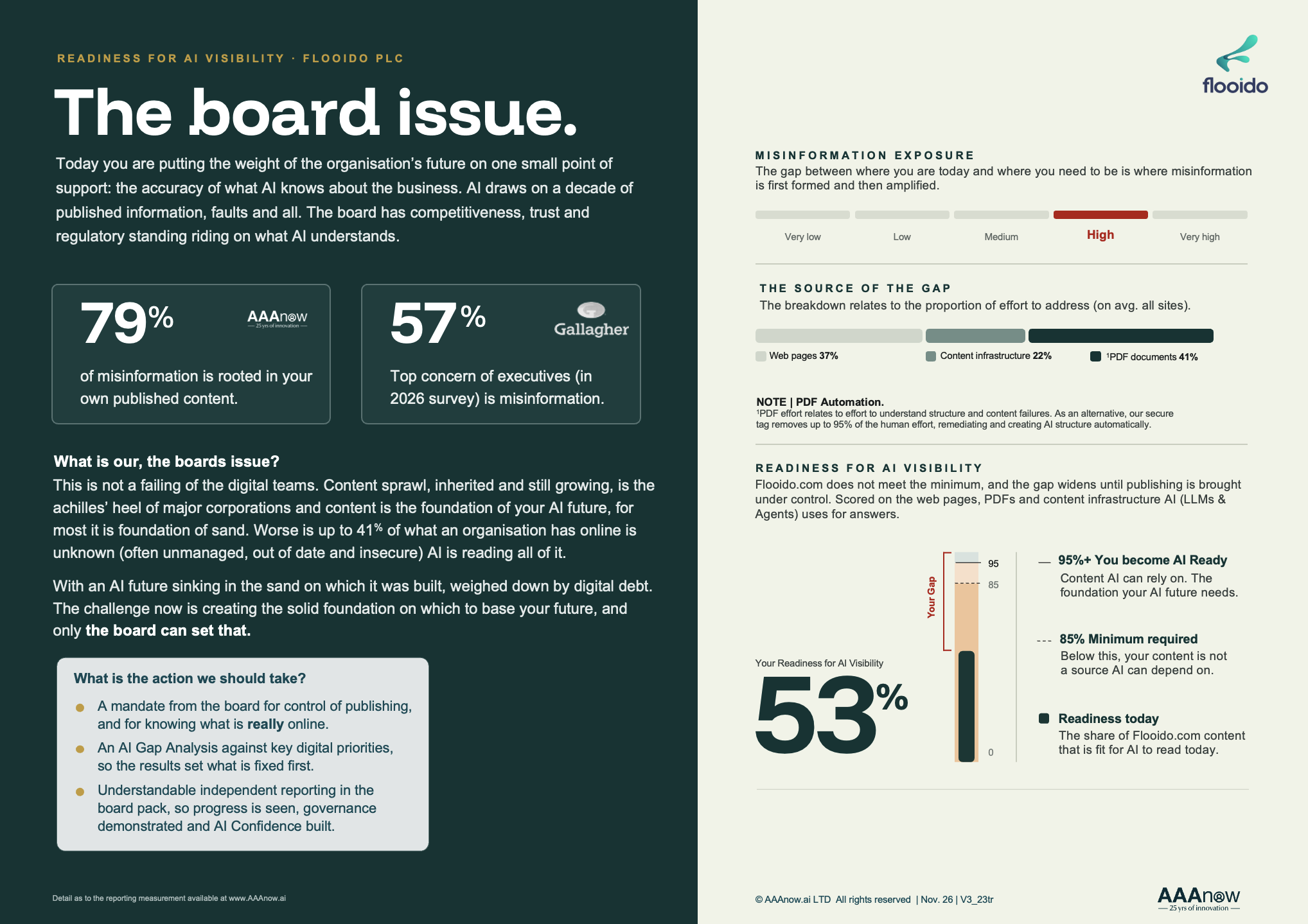
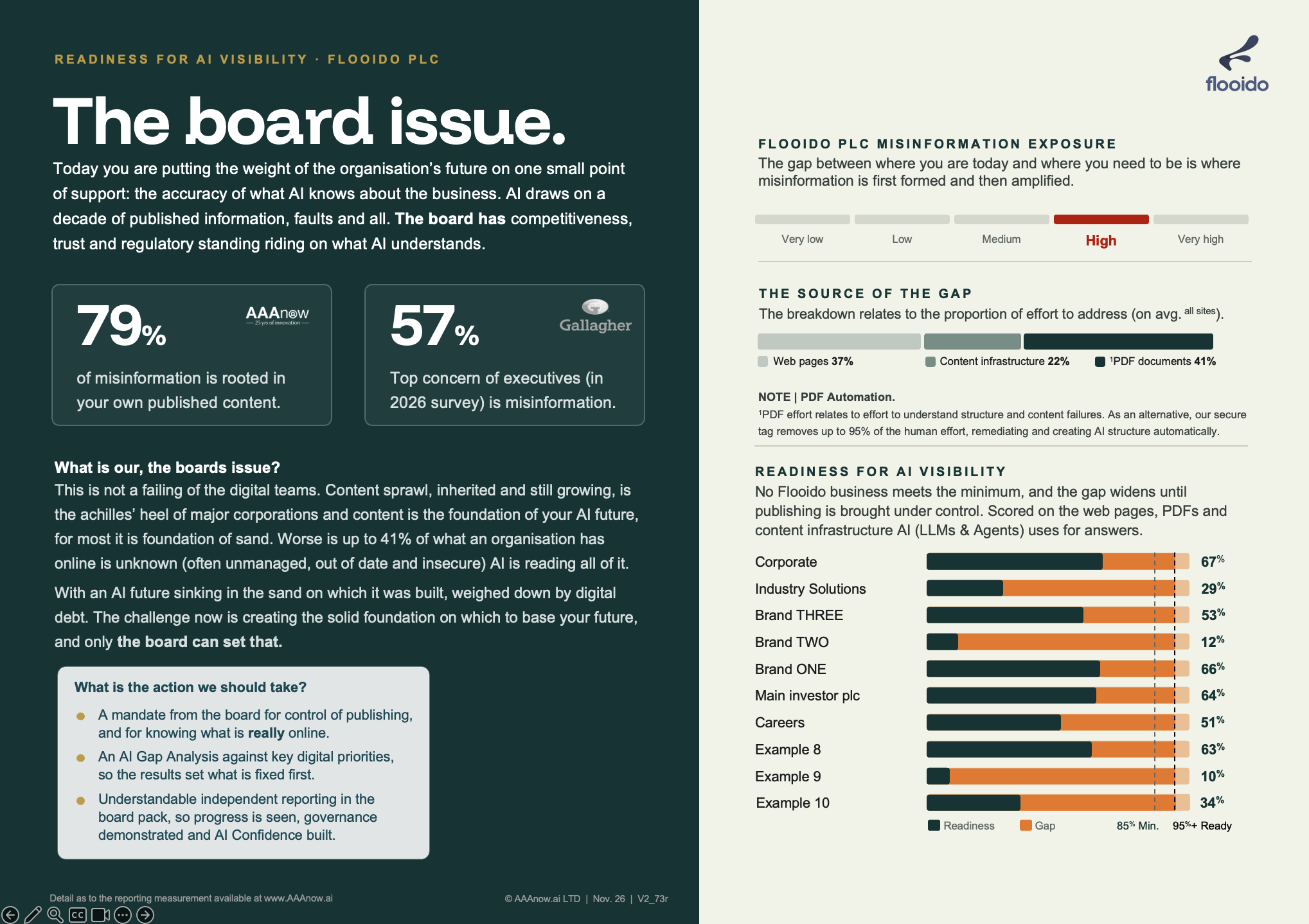
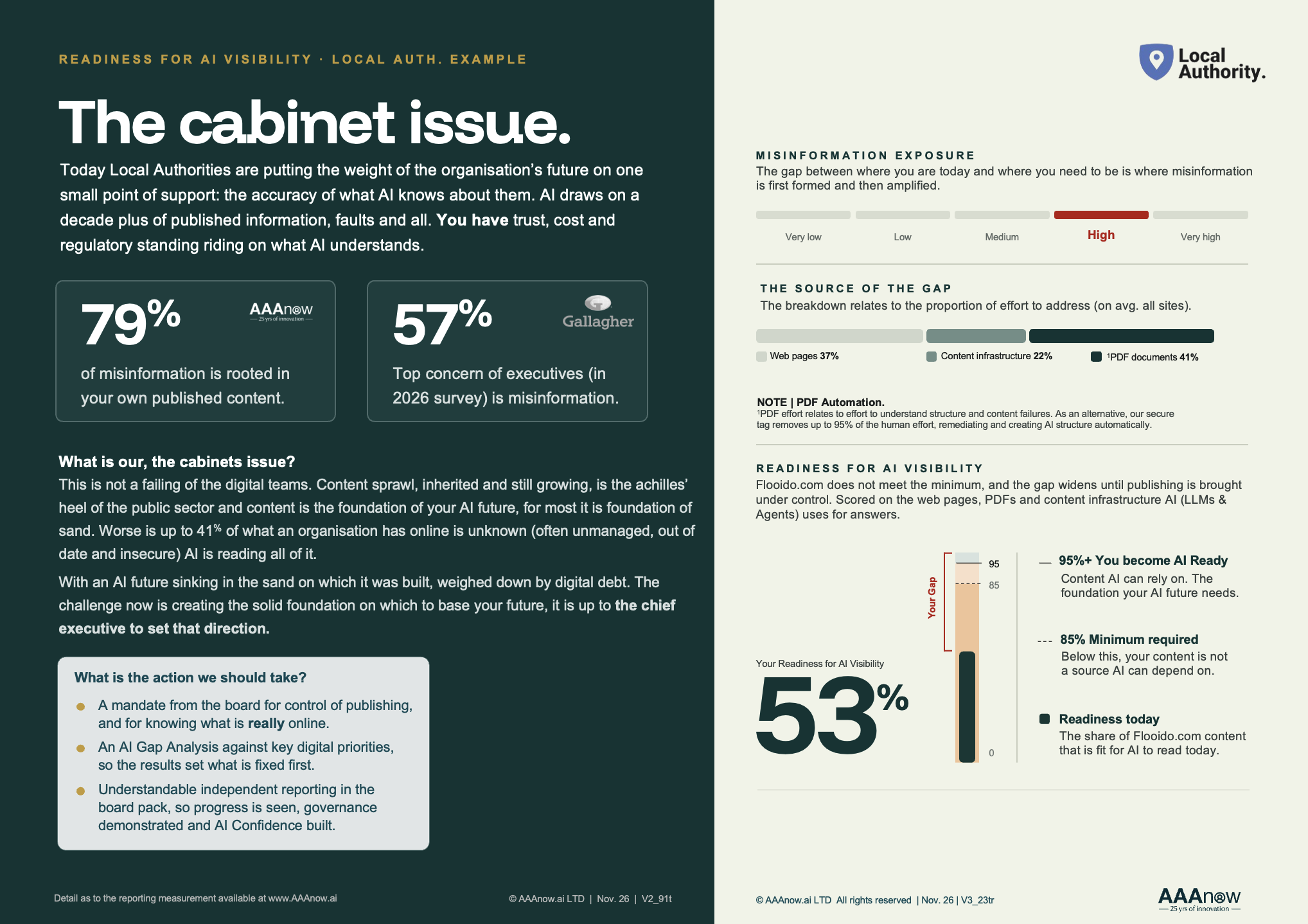
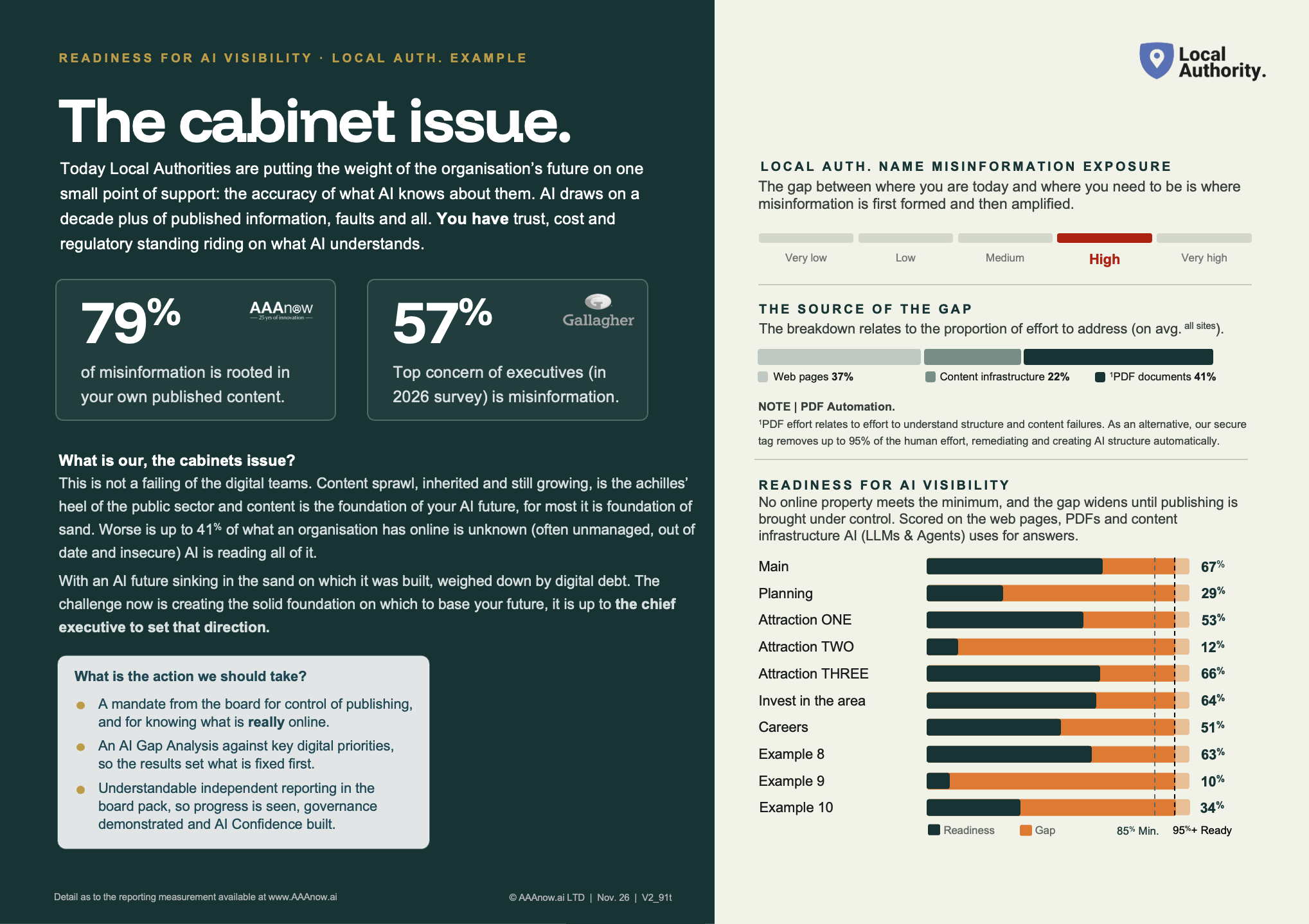
For the 79%: AAAnow Research, Dec. 2023 to Jan. 2026; P&C (human misinformation) 2014 to 2023.For the 41%: P&C / Sitemorse risk profiling, 2017 to 2023, covering more than 119 million websites.For the 57%: Gallagher, The 2026 AI Adoption and Risk Benchmarking survey.
05Who it is for.
Risk managers
Where does AI risk begin for us?
A recorded starting position for AI risk, to place alongside the other risks the organisation reports.
Heads of AI
What does AI see of our information?
The external view of the organisation’s information, beside the internal AI programmes it supports.
The board
Where are we starting from?
A first, recorded view of the position, before directors decide what to do next.
Partners
Where does our client stand?
Agencies and insurance partners request IN|SITE and share it with their clients, for the same first view.
06One website, a sector or a client’s landscape.
IN|SITE is a one-off assessment, set at a point in time. Its scope is chosen to fit the question being asked.
A single website
What does AI see of this property?
One website, read in full.
A sector
How do we compare?
A group of organisations read in the same way, so each position can be set beside the others.
A client’s landscape
Where does this account stand?
The sites and documents that make up a client’s presence, for account-based marketing (ABM).
07Included for subscribers.
IN|SITE is included on an unlimited basis for subscribers, both direct clients and partners, agencies and insurance among them.
It can be requested whenever a new starting view is needed: a new client, a new sector, or a board asking where the organisation stands.
08Commonly asked questions.
What does IN|SITE provide?
One position, at a point in time: AI Readiness on the AI Readiness Maturity Scale™, likely misinformation exposure, a breakdown by content infrastructure, web pages and PDF pages, and what AI can access and where it is prevented.
Who usually asks for it?
Risk managers, Heads of AI and boards who need a first view of where the organisation starts from, and partners who share that view with their clients.
How wide can the scope be?
A single website, a sector, or a client’s landscape for account-based marketing (ABM).
Is it a one-off?
Yes. IN|SITE is a point-in-time assessment. Following the position over time is the role of OVER|SITE - which is the reporting level of AI confidence platform .
How is it provided?
IN|SITE is included on an unlimited basis for subscribers, direct clients and partners alike.
Start from evidence
Know where the organisation stands, before deciding what to do next.
IN|SITE sets out the starting position as AI sees it. OVER|SITE and WORK|PACK build on that same reading.