01The board issue.
Today you are putting the weight of the organisation’s future on one small point of support: the accuracy of what AI knows about the business. AI draws on a decade of published information, faults and all. The board has competitiveness, trust and regulatory standing riding on what AI understands.
Nobody laid those foundations expecting AI. They met the digital standards of the day, and they held, because people found their way past the faults and nothing else depended on them. AI does depend on them, and it needs accuracy. For most, that future is built on sand and sinking, weighed down by the content debt of years of sites, PDFs and documents nobody has looked at since.
Content debt already costs money. The FT report puts the spend on fixing inaccurate or misleading content at $4.8 million a year per company, with 5.9% of annual revenue affected.2 The far greater cost is what it does to the foundation your position across AI now rests on.
For most people asking about you, AI’s answer is the only version of the organisation they meet. Customers ask it before they ask you, and so do investors, analysts, recruits and, increasingly, regulators. Decisions about you are being made from those answers today.
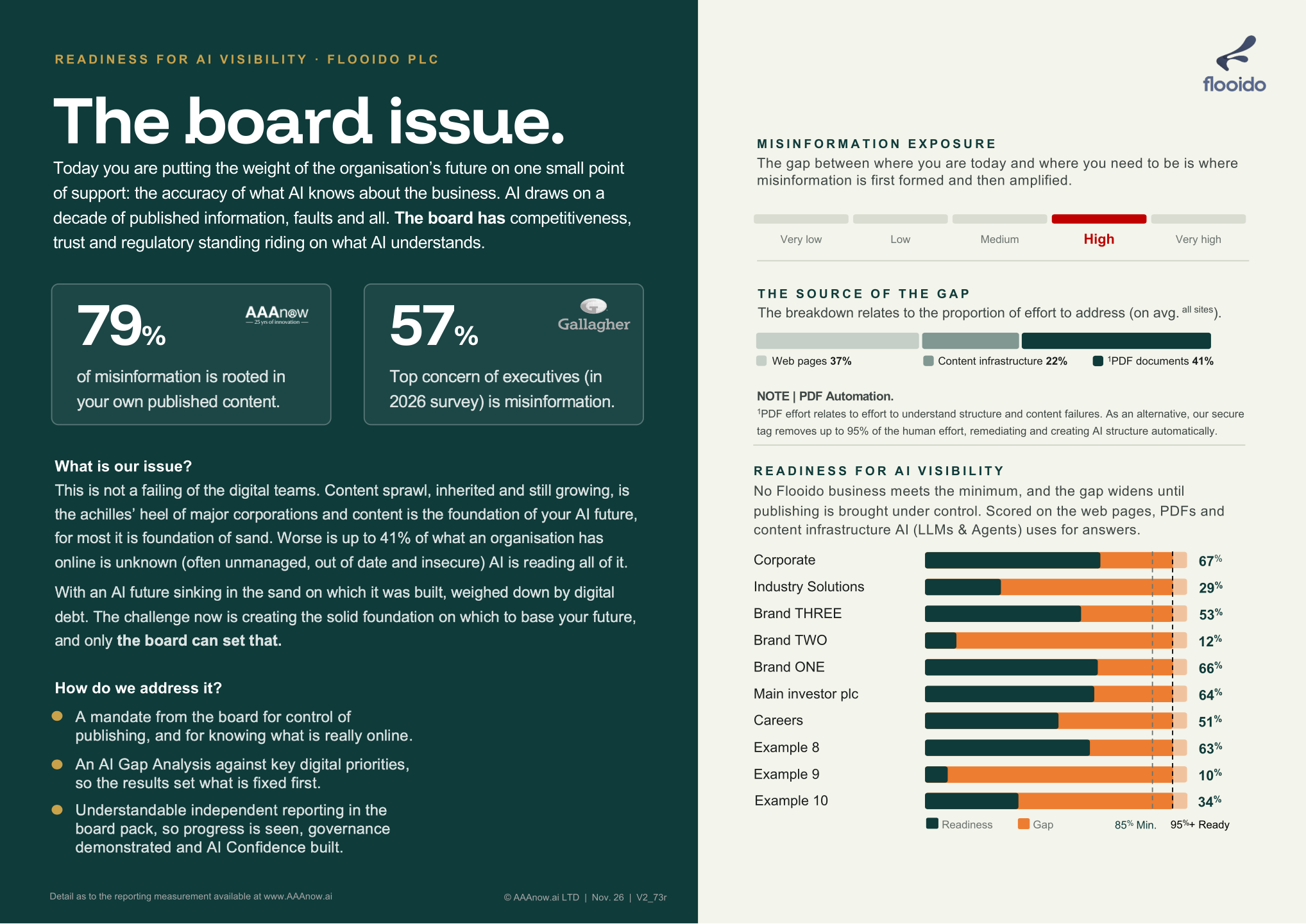
The risk itself is well known. In Gallagher’s 2026 AI Adoption and Risk Benchmarking, 57% of respondents name AI errors and misinformation the top concern threatening AI adoption.1 The instinct is to treat that as AI’s problem, yet our research traces 79% of that misinformation to the organisation’s own published content.4 AI is working from what you put there.
This is not a failing of the digital teams, and no one is to blame. It is simply what has happened. The challenge now is creating the solid foundation on which to base your future, and only the board can set that.
02Solid ground, 10 years ago.
Nobody built their digital capability thinking it was on sand. Ten years ago the websites, documents and platforms met the digital standards of the day, and met them well. AI was not in anyone’s view, and nor was taking old content down, or how PDFs would multiply as each team published what it needed. People found their way past a duplicate, an old version or a broken table without noticing.
AI reads the whole of what you have published, and it needs an accuracy from it that no person ever did. The faults have been there for years, and AI now depends on the content that carries them. For most organisations the future rests on content laid down for a world without AI, and the longer the content debt is carried, the further that future sinks into it. It has to be dealt with, because for most the future is AI.
03What AI is working from.
Content sprawl, inherited and still growing, is the Achilles’ heel of major corporations. Up to 41% of what an organisation has online is unknown to its own digital teams, and AI is reading it.5 That is the content debt: years of sites, PDFs and documents, out of date, duplicated, contradictory or incomplete, which nobody has had reason to look at since they were published.
Two further kinds of fault sit beside it. There are hidden errors that human readers missed or worked past, so they were never corrected. And there is the way content is structured, described and connected, which never needed attention because nothing relied on it, and which affects the current site as much as the old.
AI is less forgiving than people are. It needs accuracy, and content debt leaves it missing and confused. What comes out is misinformation, repeated each time the question is asked.
04Why this sits with the board.
Three things ride on what AI understands about you, and the board owns each of them. Competitiveness comes first: when AI makes the comparison and the recommendation, it puts forward the organisation it reads accurately, and the other is left correcting a picture already in use. Trust follows, since the market’s version of you is assembled from material you would not stand behind today.
Regulatory standing is the third. An organisation is held to what its own channels say, including the parts that disagree with each other. In Moffatt v Air Canada, a tribunal found the airline liable for its chatbot’s words and rejected the argument that the chatbot answered for itself.3 The correct policy sat on another page of the same site.
The FT report puts the burden of content debt at $4.63 trillion a year.2 Readiness for AI Visibility is the board’s to answer for, because only the board can set the foundation that all 3 rest on.
05Why now.
Attention has gone to what AI can do for the organisation. In the rush to do something with it, the question of what AI is working from has, in the main, not been asked. Meanwhile the spend on AI visibility, on Generative Engine Optimisation (GEO) and Answer Engine Optimisation (AEO), surfaces whatever is already in circulation, so promotion ahead of the foundation widens the gap AI reads.
A case from our own work shows how this happens.7 A major cosmetics company wanted its Christmas soap offer visible and promoted across the LLMs, through GEO and then AEO, so that a shopper asking what to buy as a different gift would find it. Behind the promotion sat the reference and support material in PDFs, which covered the use of peanuts in production areas, in multiple versions with conflicting information. Promotion amplifies the whole of what AI can reach, conflicting versions included.
Readiness for AI Visibility is the solid foundation against which promotion is done. The duplicate, old and conflicting PDFs are found first, so the visibility work is not undermined by the detail sitting somewhere else.
06The PDFs nobody considered.
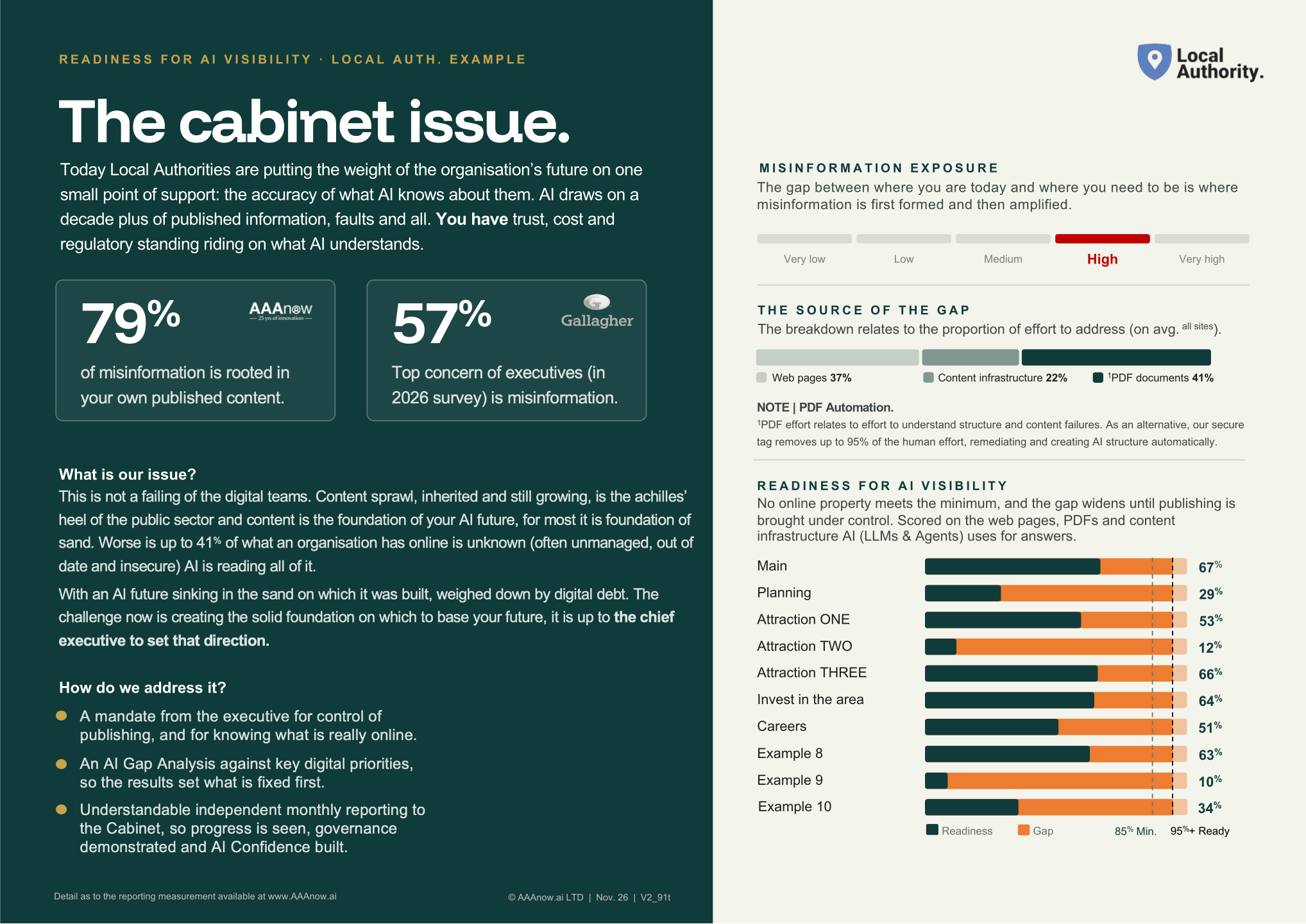
Of the effort needed to close the gap, averaged across the sites we assessed over the last 4.5 months, PDF documents take 41%, web pages 37% and content infrastructure 22%.6
PDFs were published for people, and nobody had a machine reader in mind. Two kinds of fault sit in them. The structural kind means the document is there and AI cannot take it in as written. The content kind is the errors human readers missed or worked past: in the course of the work we find wrong regulations cited, missing standards, misaligned product codes, prohibited use of trademarks and IP, and wrong safety detail.
A financial services firm had a draft report online alongside the main report, and the main report carried structural issues.7 AI cited conflicting results and misread the detail. Circa 95% of the PDF effort is addressed by automation, with a human in the loop for the rest.
07The AI Gap Analysis.
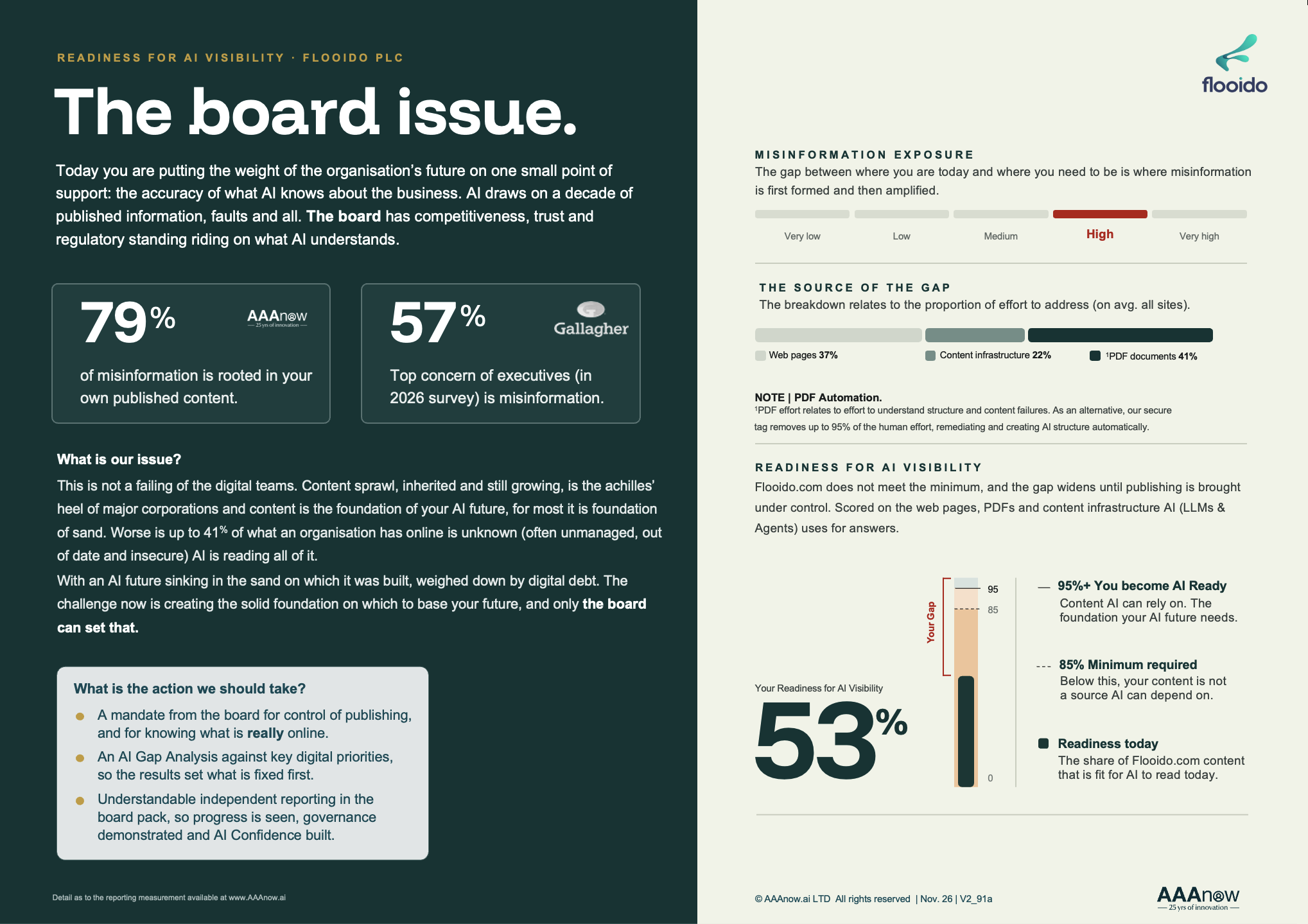
The AI Gap Analysis is the outside-in look, and until now there was no way to take it. It shows where you believe you stand, where AI’s reading puts you, and where you need to be. The minimum to mitigate misinformation is 85%, and 95% and above is ready.
It is scored on the web pages, PDFs and content infrastructure AI uses for answers, and it is run against your key digital priorities, so the results set what is fixed first. What AI then answers is a separate question, and we do not claim to know it.
For the board there are 3 moves. The first is a mandate from the board for control of publishing, and for knowing what is really online. The second is an AI Gap Analysis against key digital priorities, so the results set what is fixed first. The third is understandable independent reporting in the board pack, so progress is seen, governance demonstrated and AI Confidence built.
What rides on the AI future is the board’s, and so is the foundation under it. The question for the next board meeting is this:
Have we looked at the outside-in view AI takes of us?
08Commonly asked questions.
Is this the same as our AI programme?
It is the other half of it. The programme is what the organisation does with AI. This is what AI does with the organisation: what it finds, reads and repeats. An organisation can be advanced on the first and exposed on the second, and effort on the first leaves the second as it is.
Our published information is checked and signed off. Where are the faults?
The faults sit in the volume, and the vetted document is a small part of it. Years of sites, PDFs and documents are still online, with drafts beside finals, duplicates, old versions and contradictions. That accumulation is the content debt. Up to 41% of what an organisation has online is unknown to its own digital teams. AI reads the whole of it, and it reads structure no person ever needed to see.
Is anyone at fault?
Nobody is at fault for this. The foundations were built to the standards of the day and built well. AI was not in view, and nothing depended on the faults until AI did. This is what has happened, and the work is to deal with it.
Why is this the board’s and not the CMO’s or the CIO’s?
What rides on it, competitiveness, trust and regulatory standing, is reported to the board. The challenge now is creating the solid foundation on which to base your future, and only the board can set that. A function can run the work. The board sets the mandate and reads the result.
What does the AI Gap Analysis show?
It shows where you believe you stand, where AI’s reading puts you, and where you need to be. It sets out what AI is reading, what it needs and what to fix, against your key digital priorities, so the results set what is fixed first. It is read from the outside, the way AI reads you, with nothing to install.
Does it tell us what AI is saying about us?
It reads what AI reads, from the outside. What AI then answers is a separate question, and we do not claim to know it. The exact detail of what to correct comes from the work that follows, through the AI Accelerator.
Why do PDFs matter so much?
PDFs take the largest share of the effort to close the gap, 41% against 37% for web pages and 22% for content infrastructure, across the sites we assessed over the last 4.5 months. They were published for people, in volume, and they carry structural failures and content errors that no reader was ever asked to find.
We are already spending on AI visibility. Does this slow it down?
It makes the spend worth having. Visibility applied to a sound foundation surfaces material you can stand behind. Applied without it, visibility surfaces whatever is in circulation, conflicting versions included, and widens the gap AI reads.
What does the 85% line mean?
The minimum to mitigate misinformation is 85%, and 95% and above is ready. Below the line, the gap between where you are and where you need to be is where misinformation is first formed and then amplified.
What is the first thing to do?
Ask the question: have we looked at the outside-in view AI takes of us? Then the 3 moves follow in order. The board sets a mandate for control of publishing and for knowing what is really online. An AI Gap Analysis is run against key digital priorities. Understandable independent reporting goes into the board pack, so progress is seen, governance demonstrated and AI Confidence built.
09About the author.
Lawrence Shaw is the founder of AAAnow. He has managed the Boeing/RR 777 EMCS, launched an ISP in 1999 and an early e-commerce platform in 2002. He was integral to EU Compliance (DP) regulation-drafting across 5 countries, and has consulted in automated regulatory compliance, risk management and process methodology for both Deloitte and IBM. His e-service delivery work spans Vodafone, eBay, Merck and Oracle, including the World’s single largest client privacy deployment.
In 2023 he developed the ARTYMUS framework for AI content governance. He now applies 25+ years of compliance and risk discipline to AI readiness: the foundations, governance and visibility that determine how organisations are read by generative AI.
Sources.
- Gallagher (2026). AI Adoption and Risk Benchmarking 2026.Source of the 57% of respondents naming AI errors and misinformation the top concern threatening AI adoption. https://www.ajg.com/news-and-insights/features/ai-adoption-and-risk-benchmarking-2026Gallagher, AI Adoption and Risk Benchmarking 2026We do not enable external links - please copy and paste, you are then certain as to the link being opened
- FT report (2026). Content Debt: A $4.63 Trillion Business Liability, FT Longitude.Survey of 550 senior leaders at billion-dollar-plus companies. Source of the $4.8 million annual spend per company on fixing inaccurate or misleading content, the 5.9% of annual revenue affected, and the $4.63 trillion annual content-debt burden. https://www.storyblok.com/lp/ft-longitude-content-debt-reportContent Debt: A $4.63 Trillion Business LiabilityWe do not enable external links - please copy and paste, you are then certain as to the link being opened
- British Columbia Civil Resolution Tribunal (2024). Moffatt v Air Canada, 2024 BCCRT 149.Decision finding the airline liable for negligent misrepresentation by the chatbot on its own website. https://decisions.civilresolutionbc.ca/crt/crtd/en/525448/1/document.doMoffatt v Air Canada, 2024 BCCRT 149We do not enable external links - please copy and paste, you are then certain as to the link being opened
- AAAnow Research, the root cause of misinformation.79% of misinformation is rooted in an organisation’s own published content. AAAnow Research, Dec. 2023 to Jan. 2026; P&C (human misinformation) 2014 to 2023. https://aaanow.ai/platform/misinformation/
- P&C / Sitemorse risk profiling.Up to 41% of what an organisation has online is unknown to its own digital teams. P&C / Sitemorse risk profiling, 2017 to 2023, covering more than 119 million websites.
- AAAnow, Nov. 2026.Effort to close the gap, averaged across sites assessed over the last 4.5 months: PDF documents 41%, web pages 37%, content infrastructure 22%.
- AAAnow client work.The cosmetics case and the financial services case are real engagements, anonymised.
- Further reading.Detail of the reporting measurement behind Readiness for AI Visibility and the AI Gap Analysis. https://aaanow.ai/