
Your briefing · by invitation

AI describes you.Unseen by you.

Ask an AI system about your organisation and it answers: to buyers, investors, journalists and regulators, from whatever it can reach. The answer is being acted on today.

We always start with a briefing, private and by invitation. Covering the 2 stages of our service; foundations: understanding is the organisation fit for AI visibility, and thereafter monitoring to alert creating exposure and subsequent liabilities for the directors and officers as AI grows.

Length20 minutes
HowBy invitation, at no charge

How we work

From the first call to the commercials.

Six stages, from your request to the commercials, and who each rests with.

  1. You · with the form alongsidewith the form below

    Stage 1. Schedule the briefing.

    Request the briefing using the form; it takes a minute. We confirm the call to you with a Teams invitation.

  2. You

    Stage 2. The Q&A, ahead of the call.

    Before the call we send a few questions: which of your websites matter, and what you want answered. The call is then about your organisation and the questions you asked.

  3. Together

    Stage 3. The briefing call.

    You see what AI reaches about your organisation, what it repeats, and what that means for its visibility and for your directors and officers. Then open discussion, for as long as your questions run.

  4. For qualifying organisations

    AAAnow

    Stage 4. A first look, and your AI position report.

    We read your landscape from the outside, as AI does, and write up where you stand in an AI position report: what AI reaches, what it reads, and where its picture departs from your own. It is written for the board.

  5. Together

    Stage 5. Your position, walked through.

    We go through the report with you: what it shows for your visibility in AI, what it shows for your directors and officers, and what to do first.

  6. AAAnow

    Stage 6. Commercials.

    The commercials follow, set against what your position showed, so the decision rests on evidence. The work begins with AI Discovery.
All that we do rests on 2 questions.

Both start from the same place: what the organisation knows of itself, and what AI sees of it.

Question 1

Are we, as an organisation, fit for AI visibility, and what does that mean?

When AI can reach what you publish and read it as you intended, what it repeats about you is what you said. Fitness for AI visibility is knowing that it can.

Buyers are already there: 94% of B2B buyers state AI is an important or more meaningful source in their purchasing process.

Forrester, Buyers’ Journey Survey: B2B buyers use artificial intelligence during their purchasing process.

Question 2

Are the directors and officers becoming increasingly, and unnecessarily, exposed as AI grows?

Directors and officers should expect to be asked what the company knew and what the board oversaw. A clear position, with a record of what has changed, is the answer they can point to.

Investors are using AI too: 68% of qualified US institutional respondents use AI extensively or moderately in investment research and decision-making.

Center for Audit Quality and KRC Research, Institutional Investor Survey: AI Use, Jul. 2026.

02Where you stand

Knowing where you stand comes before being seen more.

Greater visibility adds value when what is made visible is current, consistent and understood. Each organisation is read from the outside in, as AI reads it, and placed on the AI Readiness Maturity Scale™.

ACT

AI struggles to read what the organisation publishes. The first stage, where foundations are put in place.

OPTIMISE

Foundations in place, with gaps to close.

MONITOR

The strongest position, with diligence and oversight as the organisation advances and grows.

The AI Readiness Maturity Scale™

03Board oversight

What your board sees, month by month.

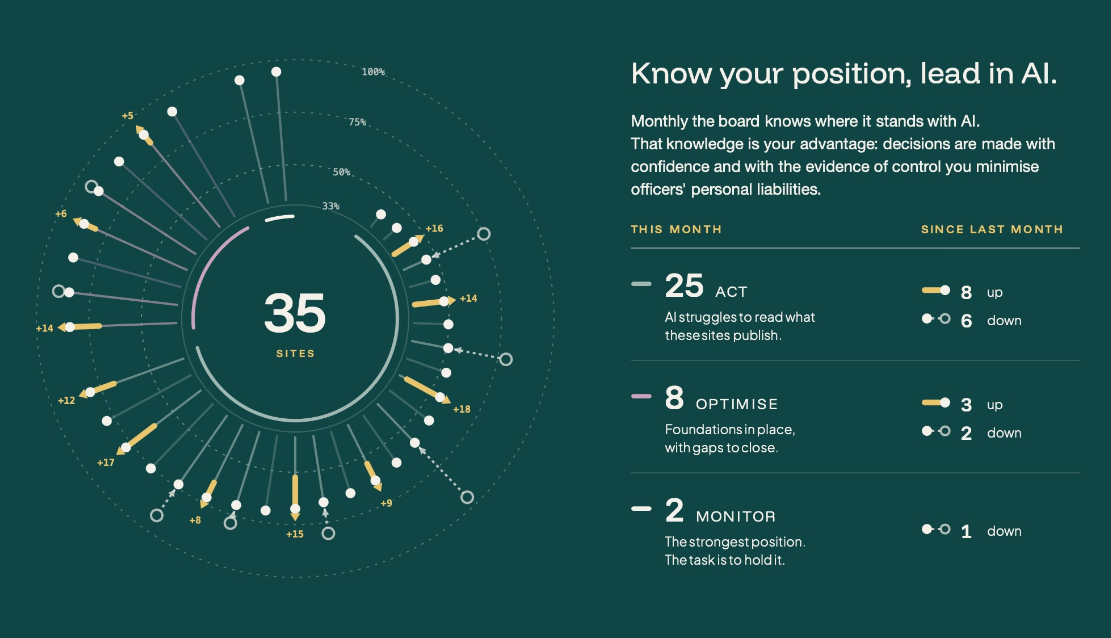
Each month the board sees which sites moved up or down the scale, and by how much.

Monthly benchmark reading, know your position, lead in AI. A ring chart of 35 sites, each shown as a spoke whose dot sits further from the centre the higher its AI Readiness, across bands of 33, 50, 75 and 100 percent. Gold arrows mark sites that moved up since last month, labelled with their gain from +5 to +18; dotted arrows ending in hollow rings mark sites that moved down. This month 25 sit in ACT, where AI struggles to read what they publish, with 8 up and 6 down; 8 in OPTIMISE, foundations in place with gaps to close, with 3 up and 2 down; and 2 in MONITOR, the strongest position, with 1 down. Read monthly, the board knows where it stands with AI and holds evidence of control. For answer engine optimisation (AEO) and generative engine optimisation (GEO), the movement shows whether the information answer engines and generative AI reach, read and repeat is improving or slipping, so visibility investment follows a position that is getting stronger.
Board oversight · Monitoring month-month

04How you compare

Benchmarked by sector, seen in 2 views.

Each organisation is read the same way and placed beside the organisations it is compared with: where they stand, and what their exposure is.

The published benchmarks

Insurance Pools benchmark, the pool as AI sees it. A ring chart of the 25 member sites, each shown as a spoke whose dot sits further from the centre the higher its AI Readiness, across bands of 20 to 50, 50 to 75 and 75 to 100 percent. Of these, 20 sit in ACT, where AI struggles to read what they publish; 3 in OPTIMISE, with foundations in place and gaps to close; 1 in MONITOR, the strongest position, where the task is to build on it; and 1 is BLOCKED, where the AI connection was refused, local AI agents were prevented or the website was not available. A since-last-month column reads NA, as this is the first reading. The chart shows how ready the membership's published information is for answer engines and generative AI to reach, read and repeat: the foundation that answer engine optimisation (AEO) and generative engine optimisation (GEO) depend on. Visibility work on a site in ACT risks amplifying material AI already misreads; establishing the position first is what gives AEO and GEO investment its value.
Insurance Pools benchmark · The pool, as AI sees it
Global Chemicals benchmark, AI Misinformation risk across the sector. A distribution curve of the 96 sites read across 4 bands of rising risk: 1 site at Low risk, the exception, where AI is likely to surface accurate information; 27 at Elevated risk, where some of what AI repeats is likely to be incorrect; 43 at High risk, AI Misinformation risk resulting in ongoing exposure; and 25 at Severe risk, where AI is very likely to repeat something incorrect. A bracket marks the concentration: 68 of the 96 sites sit in High or Severe risk. At the Severe end, a marker shows the 4 sites blocked: AI access refused, so no reading was possible and AI forms its own version. For answer engine optimisation (AEO) and generative engine optimisation (GEO) this is the measure that matters: answer engines and generative AI repeat what they find, so greater visibility for a site in High or Severe risk carries misinformation further. Knowing where the risk concentrates shows where improvement makes the greatest difference to what AI repeats.
Global Chemicals benchmark · AI Misinformation risk across the sector

05Leadership

The questions leadership asks.

A chief executive and a head of AI arrive with different questions. Each is answered from the same understanding.

01What does AI say about us today, and is it right?

AI Readiness reads the organisation as AI does, and shows where what AI is likely to repeat differs from what you know of yourself.

02How do we compare with the organisations we are measured against?

The sector benchmarks read each organisation the same way, so the board sees whether it leads, keeps pace or is falling behind. Your own position is shared with you privately.

03Are our directors and officers more exposed than they need to be?

Exposure grows when AI repeats outdated or conflicting information and the board cannot show what it knew or did. A clear position, with a record of what has changed, is the answer it can stand behind.

04What should the board be able to say about how AI risk is governed?

Where the organisation stands on the AI Readiness Maturity Scale™, where misinformation is most likely to arise, and what has been found and changed since.

05Where do we start?

With a private briefing, by invitation. It shows the board where the organisation stands before any further decision is made.

06Can AI reach the information we consider important?

Digital Doorway tests whether the AI routes that matter reach your important information. Where access is refused, AI forms its view from other sources.

07How does this relate to AEO and GEO?

Answer engine optimisation and generative engine optimisation make you more visible to AI. Knowing your position first shows where that work will help, and where it would amplify the wrong material.

08What does AI read about us beyond the corporate website?

Historic websites, old PDFs, superseded pages and project environments, often long after your position has moved on. Landscape Mapping discovers that wider estate and sets out what matters most.

09Where should our effort go first?

AI Misinformation Exposure shows where content is most likely to be misunderstood, and the risk profile shows where that likelihood concentrates. Effort goes to the material that causes the gap.

10How is progress measured over time?

Against the AI Readiness Maturity Scale™, read the same way each month. AI Confidence carries diligence and oversight across your digital landscape as the organisation advances and grows.

Your briefing · by invitation

Request