01The exposure in what is already online.
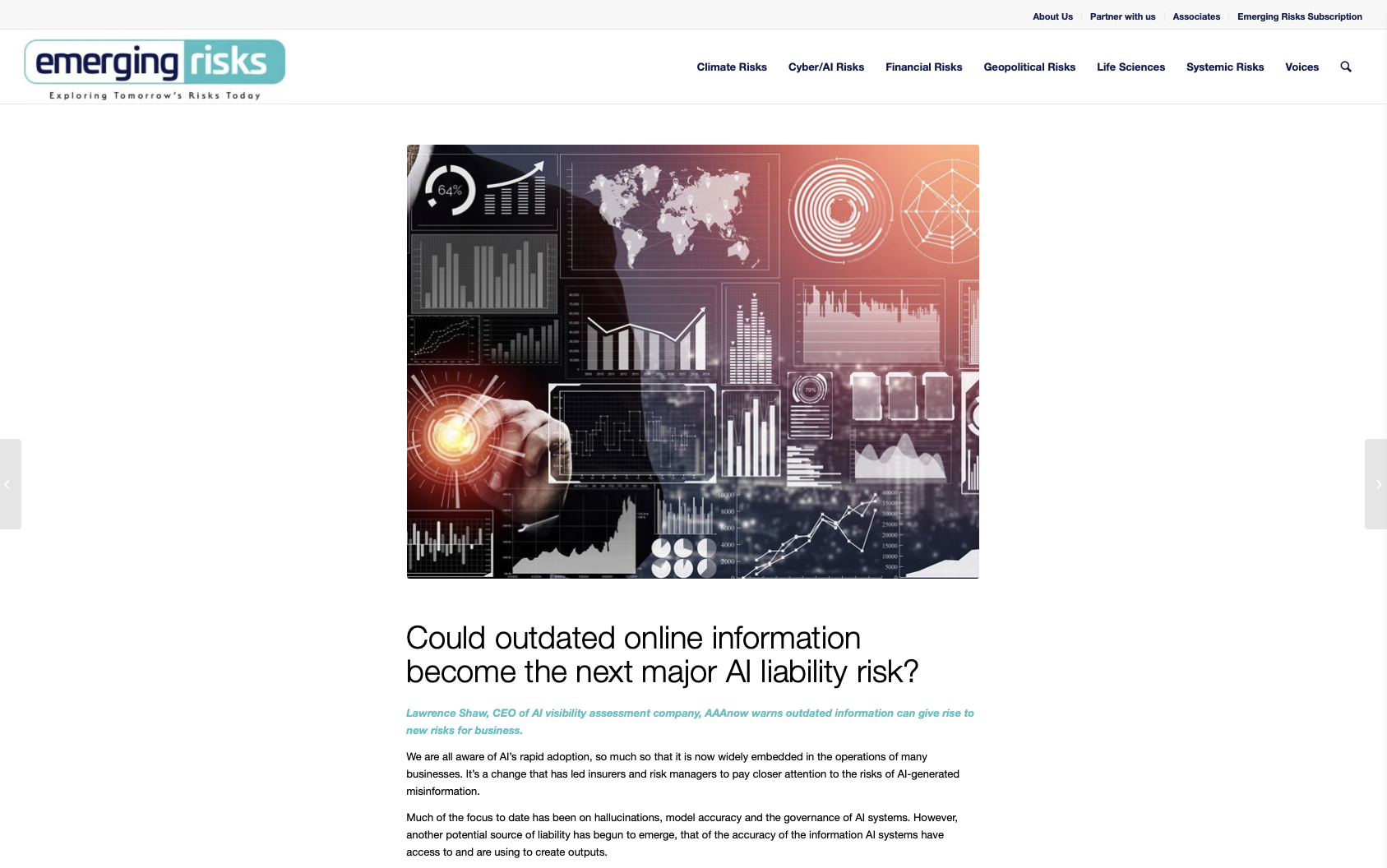
Insurers have so far judged AI misinformation by the systems that produce it. Lawrence Shaw, CEO of AAAnow, argues that the larger exposure lies in the information those systems read.1
Most organisations hold years of material across websites, intranets, document stores and databases, and some of it is wrong, out of date or contradicted elsewhere. People learned to look past it. AI reads all of it, combines it and repeats it.
Up to 41% of what an organisation has online is unknown to its own digital teams,5 and AAAnow research traces 79% of misinformation to the organisation’s own published content.4 When someone acts on an obsolete figure, a superseded safety instruction or old dosage guidance and suffers a loss, liability is hard to settle.
02When published information becomes the liability.
Shaw gives 2 anonymised cases. A pharmaceutical company still had material online about a banned drug, with outdated guidance on administering it, for AI to retrieve and repeat.
An industrial machinery manufacturer loaded flawed servicing and safety instructions into an AI system supporting its engineers. The critical isolation steps no longer appeared where the procedure needed them.
Neither case has yet produced an insured loss or a claim. Both show how an old weakness in managing information carries far more weight once AI supplies the answers people act on. The exposure runs from professional negligence and misrepresentation to product liability, regulatory scrutiny and, in some circumstances, the directors and officers.
03A question for directors and officers.
The market already ranks the risk highly. In Gallagher’s 2026 research across more than 1,200 businesses, 57% named AI errors, misinformation and hallucinations their top AI-related risk.2 Of 250 insurance professionals surveyed by The D&O Diary and Allianz Commercial, 85.6% expect AI-related regulatory, shareholder and operational claims to significantly affect D&O claims experience.3
For directors, the question could become whether reasonable steps were taken to identify and address known weaknesses in corporate information.
Aon and Lockton report rising underwriting interest in AI governance, board oversight and the accuracy of disclosures, and Allianz Commercial has flagged AI hallucinations and AI washing as emerging D&O exposures.1
04When the AI belongs to someone else.
Most systems reading a company’s information are run by others. They can present an obsolete annual report or a withdrawn specification as current, and with AI-assisted research now routine, whatever an organisation leaves publicly accessible will be examined more closely.
Underwriters are adjusting their terms. Munich Re’s aiSure examines AI inputs, training data and outputs; AXA XL’s Gen AI endorsement covers data poisoning; Beazley and Hiscox have added explicit AI wording to their policies.1 Insurers may next ask how a client controls versions, corrects errors and keeps obsolete material out of circulation.
05The broker’s advantage.
An insured needs an independent assessment of its misinformation exposure, made outside the teams who published the material and set out for its board. AAAnow provides it, and supports brokers in bringing it to their clients. The broker opens the subject with authority; AAAnow answers the technical questions that follow.
The summary answers the 2 questions a board needs to ask:
- Are we fit for AI visibility?
Readiness is scored against the 85% minimum, across the web pages, PDFs and content infrastructure AI uses for answers. - Are our directors and officers becoming increasingly, and unnecessarily, exposed as AI grows?
The summary shows where the exposure is concentrated, and where the work to reduce it lies.
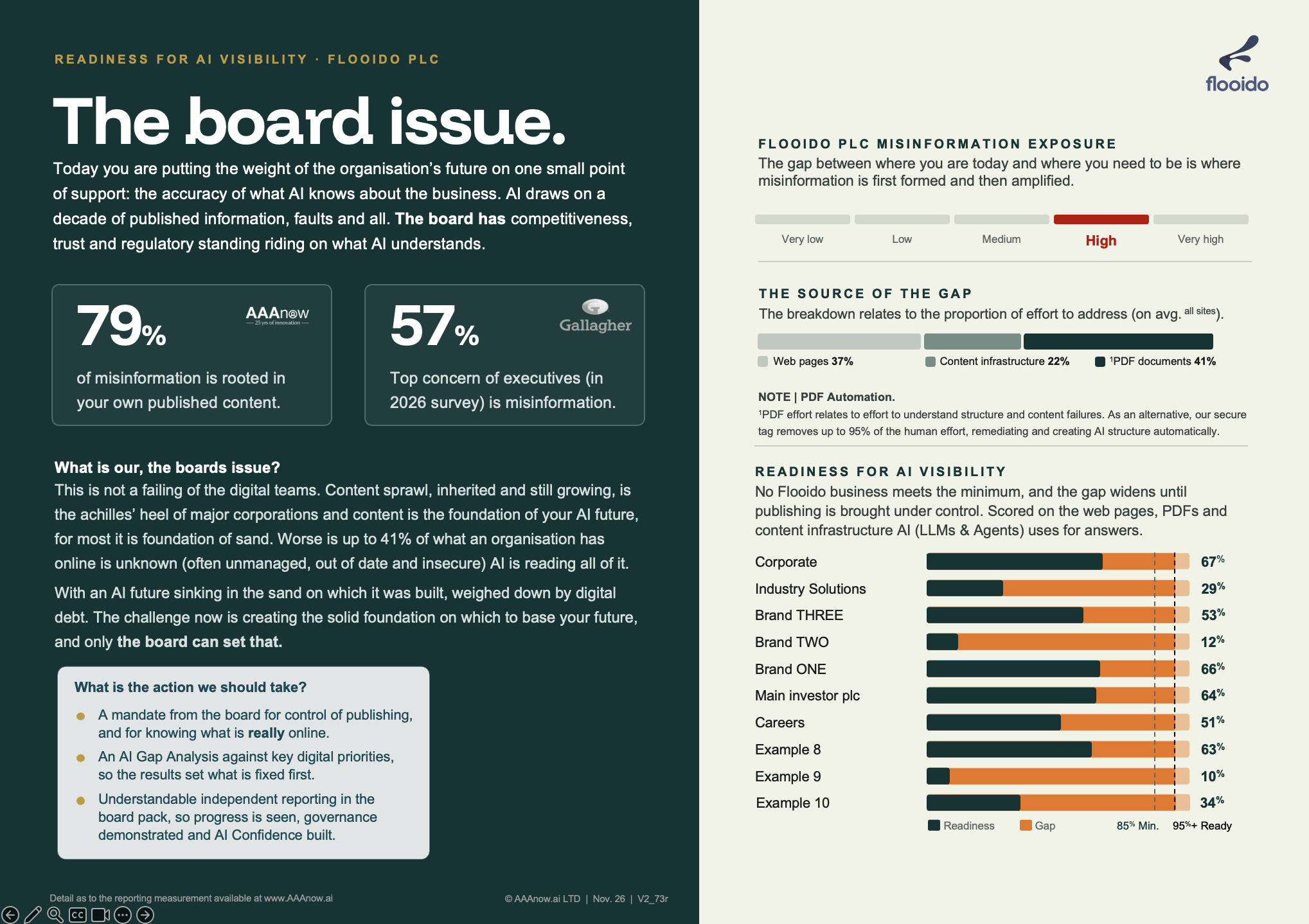
The group view is for a client with several businesses, brands or websites. Each is scored against the minimum, so the broker can show where the exposure is concentrated and why it rests with the group board, where D&O cover sits. In the illustrative Flooido example, none of the 10 businesses reaches the minimum. The summary also shows where the work lies, with PDF documents at 41%, web pages at 37% and content infrastructure at 22%, which tells the client where to direct its people first. It puts the case on 1 page, ready for the group’s risk committee or board.
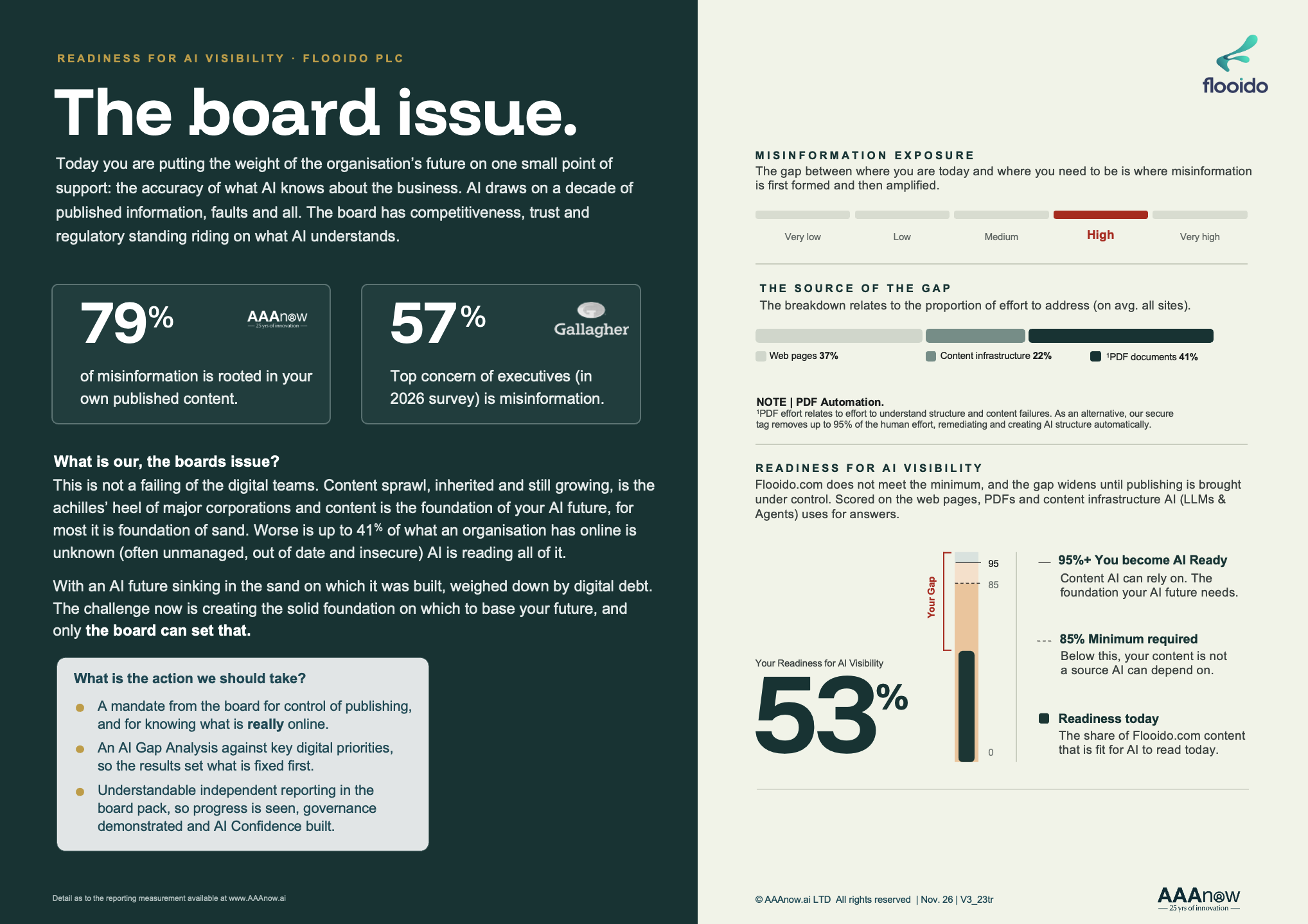
The single-site view is for a client with 1 principal website, or for a first meeting. It reduces the assessment to 1 score a board can read without explanation. Flooido.com scores 53%, against the 85% minimum and the 95% at which content is ready for AI to rely on. The distance between them is the client’s exposure today, and the summary sets out the order in which to close it. Reassessed at renewal, the score shows the client and the insurer what has improved.
Brokers can arrange an assessment for an insured at broker.aaanow.ai (opens in a new tab).
06Commonly asked questions.
Why raise AI misinformation with an insured that makes little use of AI itself?
Customers, investors and counterparties put questions about a business to AI whether or not the business has adopted it. The assessment shows what outside AI systems can reach, and where the insured’s own published information could feed a misleading answer. Gallagher’s 2026 survey ranks AI errors, misinformation and hallucinations first among the perceived threats from AI adoption.2
How does the summary help in a conversation about cover?
It puts the insured’s exposure to likely misinformation on record, at renewal or between renewals. Liability and cover remain for the policy, the insurer and, in a dispute, the courts. If the insured then commissions corrective work and monitoring, that work can be documented as evidence of mitigation, and Aon identifies governance and documentation as central to underwriting confidence.6
How does a broker arrange an assessment for an insured?
Complete the request at broker.aaanow.ai (opens in a new tab) with your name, your email address and the name of the insured organisation. The request also records whether the concern is the company’s exposure, the liability of its directors and officers, or both.
Does the exposure sit with the company or with its directors and officers?
It can sit with both. The company faces the claims Shaw describes, from professional negligence and misrepresentation to product liability and regulatory scrutiny. For the directors and officers, the test is whether reasonable steps were taken to find and correct known weaknesses in the information the company published. The summary records the insured’s starting position on both, covering what AI can reach and interpret on its website and in its PDFs.
Does the broker need to understand AI to raise it?
The summary is written for a board, in plain terms, so the broker can present it as it stands and open the subject with authority. AAAnow answers the technical questions that follow, directly with the insured’s teams.
Can carrier funding pay for an insured’s AI Readiness audit?
Carrier marketing or support funds can be used to pay for a detailed AI Readiness audit for an insured, setting out each finding behind the summary.
How does this sit alongside a cyber assessment?
It follows the same principle, giving the insured a clear view of where it stands, applied to a different subject: the information the organisation has published, and whether AI can find it and read it correctly.
Can AAAnow help brief several insureds at once?
AAAnow works with brokers on events, webinars and sector briefings. The broker introduces the risk to the group, and any insured that wants to understand its own position can then take an individual assessment.
What can a broker show an insured before requesting a report?
An example report, built around a fictional company, shows how the summary presents an organisation’s exposure to misinformation. Brokers use it to open the subject with a current insured or a former contact. View the example report (opens in a new tab).
What if the insured wants to track its exposure over time?
AAAnow can reassess once changes have been made, or provide ongoing diligence and oversight through AI Confidence, with independent reporting as the organisation advances and grows.
Sources.
- Emerging Risks (2026). Could outdated online information become the next major AI liability risk?Lawrence Shaw, CEO of AAAnow, in the Voices section, 13 Nov. 2026. Source of the 2 anonymised cases and of the industry developments summarised here (Aon, Lockton, Allianz Commercial, Munich Re, AXA XL, Beazley and Hiscox). https://www.emergingrisks.co.uk/could-outdated-online-information-become-the-next-major-ai-liability-risk/Emerging Risks, Could outdated online information become the next major AI liability risk?We do not enable external links - please copy and paste, you are then certain as to the link being opened
- Gallagher (2026). AI Adoption and Risk Benchmarking 2026.Research across more than 1,200 businesses. Source of the 57% ranking AI errors, misinformation and hallucinations as their top AI-related risk, as reported in Emerging Risks. https://www.ajg.com/news-and-insights/features/ai-adoption-and-risk-benchmarking-2026Gallagher, AI Adoption and Risk Benchmarking 2026We do not enable external links - please copy and paste, you are then certain as to the link being opened
- The D&O Diary and Allianz Commercial (2026).Survey of 250 insurance professionals. Source of the 85.6% agreeing that AI-related regulatory, shareholder and operational claims will significantly affect D&O claims experience, as reported in Emerging Risks.
- AAAnow Research, the root cause of misinformation.79% of misinformation is rooted in an organisation’s own published content. AAAnow Research, Dec. 2023 to Jan. 2026; P&C (human misinformation) 2014 to 2023. https://aaanow.ai/platform/misinformation/
- P&C / Sitemorse risk profiling.Up to 41% of what an organisation has online is unknown to its own digital teams. P&C / Sitemorse risk profiling, 2017 to 2023, covering more than 119 million websites.
- Aon (2026). AI Risk 2026: What Business Leaders Need to Know.Published 7 May 2026. Source of governance and documentation as central to underwriting confidence in AI risk. https://www.aon.com/en/insights/articles/ai-risk-2026-practical-agendaAon, AI Risk 2026: What Business Leaders Need to KnowWe do not enable external links - please copy and paste, you are then certain as to the link being opened
Note to editors.
For media enquiries, please contact:
James Simpson
Managing Director, TMCC Marketing
+44 (0)1372 724686
[email protected]
tmccmarketing.co.ukTMCC MarketingWe do not enable external links - please copy and paste, you are then certain as to the link being opened