
01From the position to the work.
IN|SITE and OVER|SITE show where the organisation stands and where the position has moved. The people who carry out the work need more: the pages and documents concerned, the order in which to take them, and what to change in each.
WORK|PACK provides that detail. It turns a reading of the position into a sequence of work, so effort goes first to the items with the greatest Value and Risk impact.
02The 3 levels of detail.
WORK|PACK is the third of 3 levels of detail the Platform provides.
- 01
One-off, point in time
Where you start: AI readiness, misinformation exposure, and what AI can reach.
- 02
Ongoing
How the position moves over time, with significant change brought to attention.
- 03
WORK|PACK
Following on, for action
What to correct, in what order, why, and how to do it.
It draws on the position set out by IN|SITE and the change followed by OVER|SITE.
03What WORK|PACK sets out.
What to correct
Which pages and documents?
The web pages and PDF pages concerned, with their importance and consumption data, so each item can be judged in context.
In what order
Where do we begin?
The items ordered by Value and Risk impact, so the sequence of work follows the position.
Why
Why does this item matter?
The reading behind each item: the readiness, exposure or access finding that placed it on the list.
How
What do we change?
The correction required, described for the person who will make it.
04What a check looks like.
Each item in a WORK|PACK is a check that can be read on its own. This one comes from a live assessment, where the site published no list of its own pages. The 6 numbered parts are the same on each item.
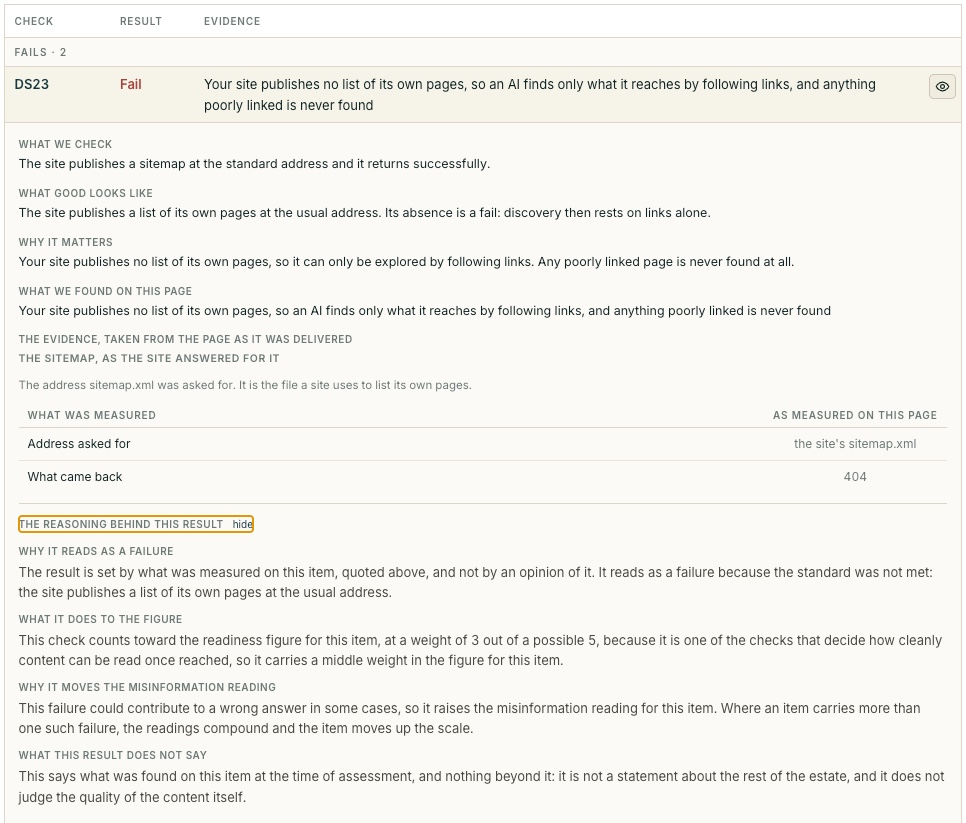
Check DS23
1 check, 6 parts. From a live assessment, where the site published no list of its own pages.
- The result. The check, its result and the finding in 1 line: here DS23, a fail.
- What we check. The standard, set out in plain words.
- What good looks like. The state to reach, so the correction has a clear end point.
- Why it matters. What the fault does to how AI finds and reads the site.
- The evidence. What was measured, as the site answered: sitemap.xml asked for, 404 returned.
- The reasoning. Why it reads as a failure, its weight in the readiness figure (3 out of 5) and its effect on the misinformation reading.
With the standard, the evidence and the reasoning in 1 place, the person making the correction knows what to change, and how to tell when it is done.
05Who it is for.
Agencies
What do we propose to the client, and why?
Account and delivery teams prepare the work for a client with the evidence behind each item, which sets the scope and the order of what the agency proposes.
Head of Digital
What does the team take on first?
A sequence of work for the team and its suppliers, set against the position the board sees.
Content and web teams
What exactly needs to change?
The page-level detail needed to make each correction.
06What the work looks like.
Each item in a WORK|PACK is a check that can be read on its own: what was looked at, the standard, what was found, and the reasoning behind the result. The 10 sheets below come from live assessments of PDF documents, web pages and the infrastructure of a site, with client details blurred. Select any sheet to read it in full.
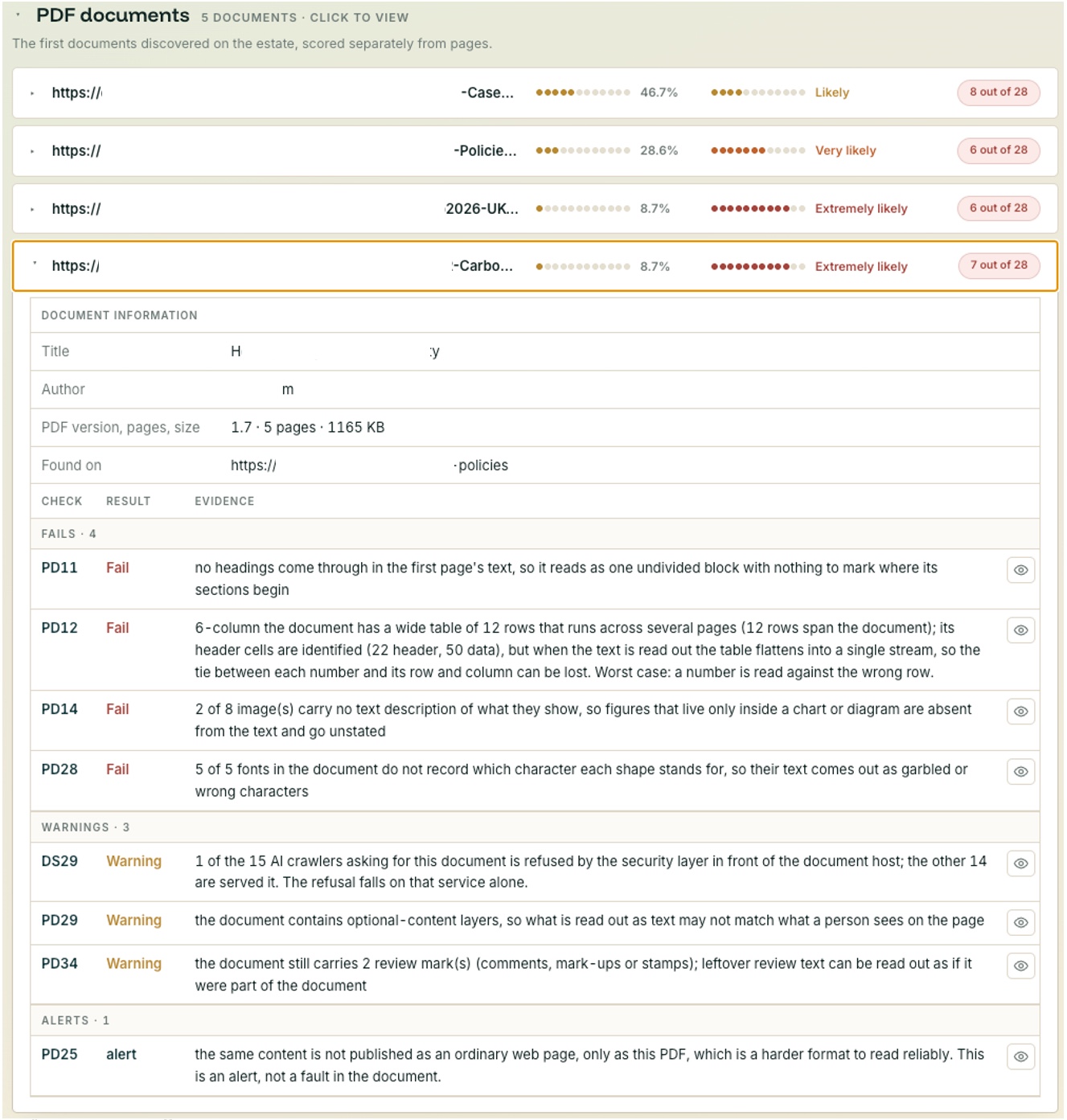
01 · PDF documents
Each document, read in its own right.
A PDF is scored separately from the pages that link to it, on what AI can take from the file itself.
- The documents found on the estate are listed, here 5, each scored separately from the pages.
- Each carries its readiness figure and how likely it is to leave AI with a wrong answer.
- Opened, a document lists what failed: here 4 fails, 3 warnings and 1 alert.
02 · Web pages
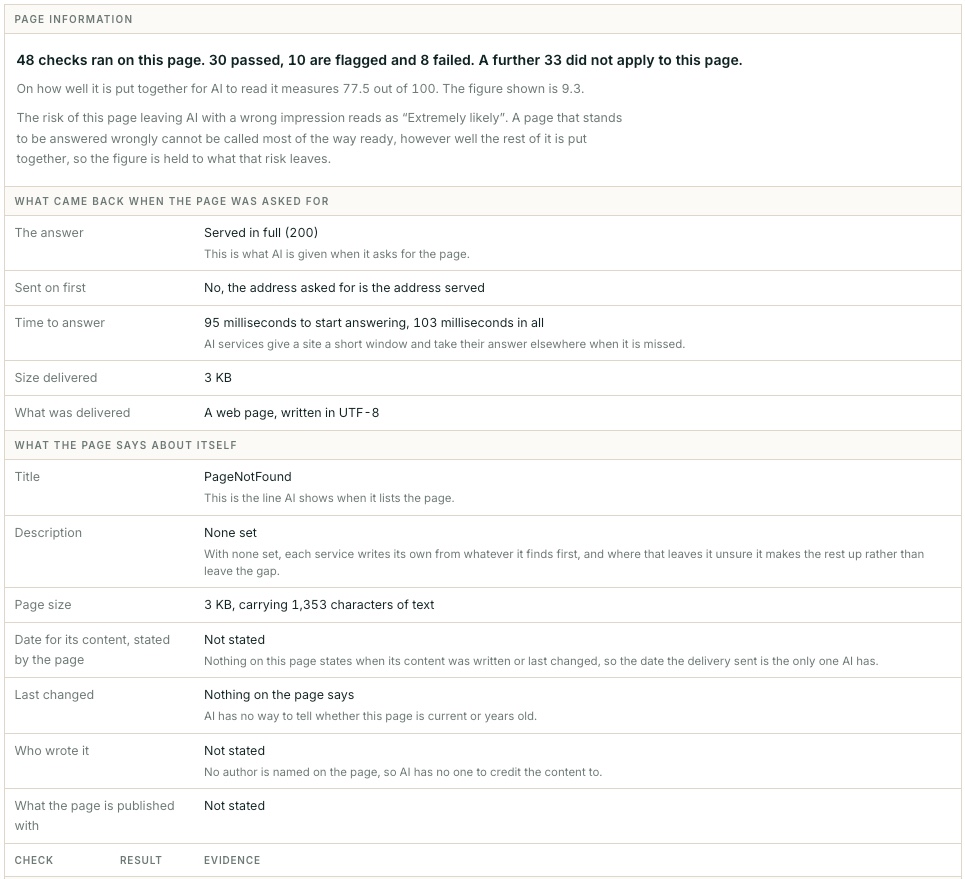
The page, as AI receives it.
What came back when the page was asked for, and what the page says about itself.
- On this page 48 checks ran: 30 passed, 10 flagged, 8 failed.
- The risk of a wrong impression reads Extremely likely, so the figure is held to 9.3.
- The page titles itself PageNotFound, the line AI shows when it lists the page.
- No description is set, so each AI service writes its own.
03 · Site infrastructure
What the site says about itself.
The files and pages that decide what AI can find on a site, and whether it trusts what it finds.
- DS23: the site publishes no list of its own pages.
- Its sitemap.xml was asked for, and 404 came back.
Each item reads the same way, wherever it was found, so the person making the correction has the standard, the evidence and the reasoning in 1 place, and the order of work follows the position.
07Resource placed where it delivers the most value.
Ordering the work by Value and Risk impact means the first hours of effort go to the items that carry the most weight in what AI sees of the organisation.
Each correction can then be followed through OVER|SITE, so the change it makes is recorded in the readings that follow.
08Commonly asked questions.
When is a WORK|PACK used?
When the position calls for action: after an IN|SITE assessment, or when OVER|SITE brings a significant change to attention.
Who is it written for?
The people who carry out the work: agency account and delivery teams, the Head of Digital, and content and web teams.
How is the work ordered?
By Value and Risk impact, so the items with the greatest weight come first.
Does it say how to make each correction?
Yes. Each item sets out what to correct, why it matters, and how.
From reading to action
The detail to act on, in the order that counts.
WORK|PACK completes the 3 levels of detail: the position, its movement, and the work that follows.