
01The answer a customer acts on.
When Which? asked ChatGPT where to put £25,000, Marcus by Goldman Sachs was among the options it named at 4.5% AER. The rate available from Marcus at the time was 3.75%, Which? found.1
A saver acting on the answer would have arrived expecting a higher rate. If an AI answer gets a rate or an eligibility rule wrong, the bank can lose the enquiry before anyone there has a chance to correct it.
Citizens Advice told the FCA’s Mills Review that clients had acted on poor AI advice. Some clients doubted their advisers when an AI answer contradicted them.2
02Where the misinformation starts.
An AI service that misstates a bank’s terms is usually repeating something the bank published, or failing to reach something it did. AAAnow research traces 79% of misinformation to the organisation’s own published content,3 and up to 41% of what an organisation has online is unknown to its own digital teams.4
For a bank, much of that content sits in PDFs: the rate sheets, terms, fee schedules and eligibility rules a customer’s question turns on. Each can produce a wrong answer in 3 ways.
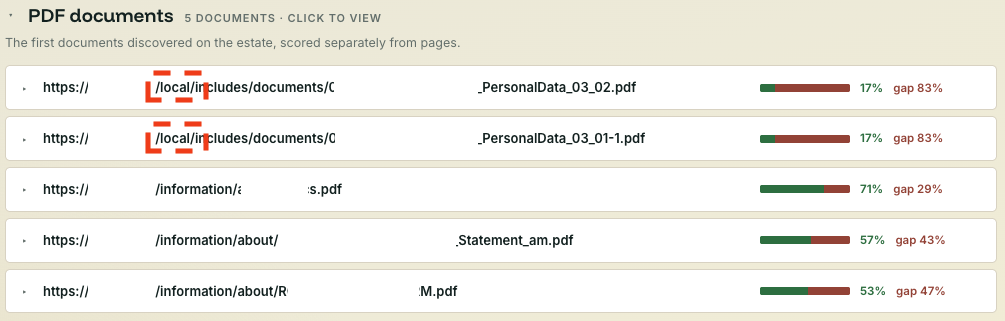
Documents AI cannot reach. An AAAnow assessment of an international bank, anonymised here, found that access settings restricted the retrieval of its PDFs. Files under /local/ appeared to be served differently from those under /information/. The 2 documents under /local/ score 17% for Readiness for AI Visibility, against 53% to 71% for those under /information/.
OpenAI and Anthropic both describe how site owners can restrict their search crawlers.5, 6 When the PDF that sets out an exception to an eligibility rule is out of reach, one service can apply the general rule to a customer it does not cover, while another retrieves the exception and answers differently. An agent working from the incomplete answer can then recommend the wrong next step.
Documents AI misreads. Without the tagged structure that tells a machine how to read a PDF, a service can take a figure from the wrong column of a table or drop the footnote that qualifies a rate.7
Versions that should have gone. Superseded rate sheets and terms left online stay available to AI, which can present them as current. Material the bank’s own teams no longer know about is the hardest to withdraw.
In each case the error starts in the bank’s own publishing, which is where it can be corrected.
03What content debt costs.
In a Storyblok and FT Longitude survey of 550 leaders at large companies across several sectors, finance among them, respondents estimated that their companies spent $4.8 million on average fixing content debt. Maintaining existing digital content took 105 staff hours a week on average. The leaders estimated that content debt put 5.9% of annual revenue at risk on average.8
AI compounds the cost of content debt. Greater AI Visibility can spread the resulting error.
Readiness for AI Visibility starts outside the bank. Check the answer and its citations against the terms that apply to the customer’s product and market.
04The view a board needs.
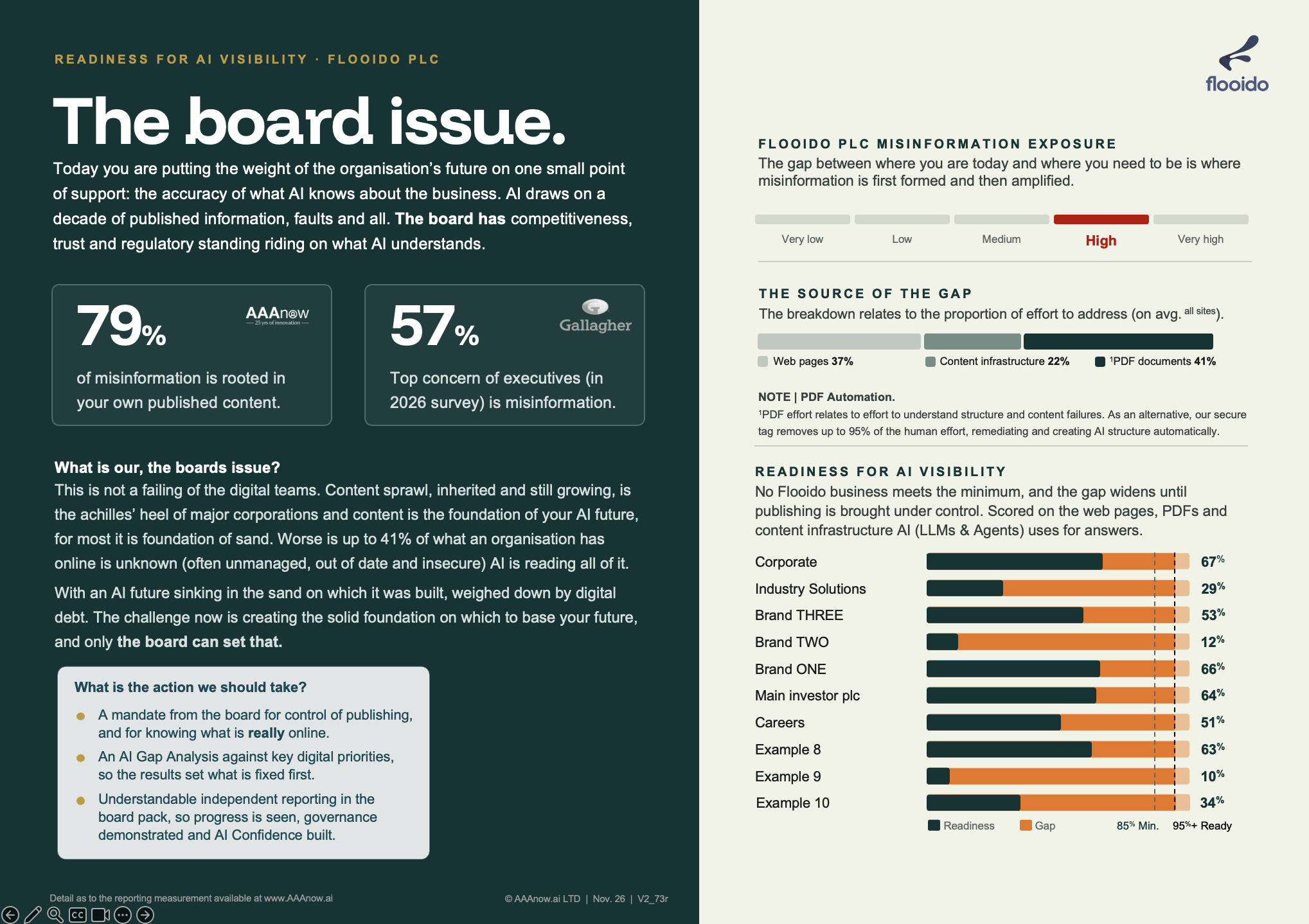
An AI Gap Analysis scores the bank’s websites and documents from outside, as AI meets them, and sets the result out on 1 page. The example shown, built for a fictional group, Flooido PLC, is the format directors receive.
Each business or site is scored for Readiness for AI Visibility against an 85% minimum, with 95% as ready. The group’s misinformation exposure is rated, and the effort needed to close the gap is divided between web pages, content infrastructure and PDF documents.
In the example, no business reaches the minimum, and PDF documents carry the largest share of the effort. In a bank, those are the documents that hold its rates, terms and eligibility rules.
05A board mandate for published information.
Compliance establishes which terms apply in each market. Digital teams identify the versions still online, and network teams check which ones AI services retrieve.
The board can put these teams under a single publishing mandate and set the rules for who owns and corrects the information. Management can then use the findings of the AI Gap Analysis alongside the bank’s digital priorities to decide what to fix first.
Independent reporting in the board pack should record what the service said, the source it used, who corrected the error and what retesting found. If a customer complains or a regulator asks, that record shows what the bank published and how it responded.
06What leaders should be able to answer.
The questions start with where the bank stands, then follow the path an answer takes, from the documents the bank publishes to the record its directors see. Beneath each is what a sound answer shows.
- How does our position compare with the other banks in our market?
A sector benchmark scores each bank on the same basis, from outside, as AI finds it. The bank above was assessed in AAAnow’s AI Readiness benchmark of the banking sector in Armenia and surrounding countries, prepared for a presentation in Armenia. - Have we mapped where our PDFs are published across sites, markets and download areas, including older files that are still online?
A sound answer is 1 inventory of the PDFs across all sites, markets and download areas, with each file’s date and owner, older files included. - Which PDFs contain terms, figures or instructions that could change what a customer does if AI misstates them?
Rates, fees, eligibility rules, deadlines and instructions come first. They are where a misstatement changes what a customer does, so they set the order of work. - Which PDFs can the AI services we test find and retrieve, and where does actual access differ from what we intend?
Retrieval is tested service by service, from outside the bank, and set against the access the bank intends. The bank above shows how far the 2 can differ. - When an AI service opens a PDF, what text and figures does it actually extract from scans, tables and pages with more than 1 column?
What each service extracts is compared with the published document. Scans, tables and pages with more than 1 column are checked first, because their order and labels depend on structure a machine may not see. - What have we done to structure our PDFs so AI systems can read the headings, follow the intended order and match table values to the right labels?
Tagged headings, a set reading order and table headers tied to their values, as W3C guidance for PDF sets out, give a machine the structure a reader sees. - When AI uses a rate, deadline or instruction from a PDF, does it carry over the conditions, exceptions and footnotes that qualify it?
Testing shows it: the answer, with its conditions, exceptions and footnotes, set against the source, for the products where a missing condition changes the outcome. - When several PDFs are online, how do we identify the current version for the customer’s market and product, and which version do AI services actually use?
Each document carries its market, product and effective date, superseded versions are withdrawn or clearly marked, and testing confirms which version AI services retrieve. - When we ask different AI services the same question, what does each answer omit or misstate, and does its citation support what it says?
The same questions go to several services, and each answer and citation is checked against the terms that apply to the customer. Where the services disagree, the bank’s information is incomplete or hard to retrieve. - Have we tested what an AI agent advises or does when it cannot retrieve the PDF that sets out a required step or an exception?
Agent journeys are tested with the key document out of reach, to see whether the agent stops, asks or proceeds on the general rule. - When an error can change a customer’s decision, can directors see the question, source and answer, who handled it and what retesting showed?
Independent reporting in the board pack records each of these. It is the record a director needs when a customer complains or a regulator asks.
Sources.
- Which? (2026). Can AI really find you the best savings deal?Matthew Jenkin, 26 Mar. 2026. ChatGPT tested on 10 Mar. 2026. Source of the Marcus by Goldman Sachs rate named at 4.5% AER, against the 3.75% available. https://www.which.co.uk/news/article/can-ai-really-find-you-the-best-savings-deal-aAy2E6f4ElkyWhich?, Can AI really find you the best savings deal?We do not enable external links - please copy and paste, you are then certain as to the link being opened
- Citizens Advice (2026). Response to the FCA’s review into the long-term impact of AI on retail financial services (The Mills Review).Submitted Mar. 2026, published 6 Jul. 2026. Source of clients acting on poor advice from AI, and of clients doubting advisers when an AI answer contradicted them. https://www.citizensadvice.org.uk/policy/publications/review-into-the-long-term-impact-of-ai-on-retail-financial-services-the-mills-review/Citizens Advice, response to the Mills ReviewWe do not enable external links - please copy and paste, you are then certain as to the link being opened
- AAAnow Research, the root cause of misinformation.79% of misinformation is rooted in an organisation’s own published content. AAAnow Research, Dec. 2023 to Jan. 2026; P&C (human misinformation) 2014 to 2023. https://aaanow.ai/platform/misinformation/
- P&C / Sitemorse risk profiling.Up to 41% of what an organisation has online is unknown to its own digital teams. P&C / Sitemorse risk profiling, 2017 to 2023, covering more than 119 million websites.
- OpenAI. Overview of OpenAI crawlers.How site owners can control access by OpenAI’s crawlers, including the crawler used for search. https://developers.openai.com/api/docs/botsOpenAI, Overview of OpenAI crawlersWe do not enable external links - please copy and paste, you are then certain as to the link being opened
- Anthropic. Does Anthropic crawl data from the web, and how can site owners block the crawler?How site owners can restrict access by Anthropic’s crawlers. https://support.claude.com/en/articles/8896518-does-anthropic-crawl-data-from-the-web-and-how-can-site-owners-block-the-crawlerAnthropic, crawler guidance for site ownersWe do not enable external links - please copy and paste, you are then certain as to the link being opened
- W3C. PDF Techniques for WCAG 2.0.Techniques for tagging headings, tables and reading order in PDF documents. https://www.w3.org/TR/WCAG20-TECHS/pdfW3C, PDF Techniques for WCAG 2.0We do not enable external links - please copy and paste, you are then certain as to the link being opened
- Storyblok and FT Longitude (2026). Content Debt: A $4.63 Trillion Business Liability.Survey of 550 senior leaders in the US, UK, Germany, Australia and the Netherlands, 16 May to 8 Jun. 2026, at organisations with at least $1 billion in annual revenue. Source of the $4.8 million, 105 hours and 5.9% averages, as published by Storyblok on 11 Aug. 2026. https://www.storyblok.com/mp/trillion-dollar-problem-unmanaged-contentStoryblok and FT Longitude, the cost of content debtWe do not enable external links - please copy and paste, you are then certain as to the link being opened