
Investors are using AI to research opportunities and develop investment ideas, according to HSBC’s 2026 survey. For boards, the concern is whether the company’s results and latest guidance are represented accurately when investors consult AI.
An investor’s AI analysis can draw on superseded guidance, conflicting public statements or financial figures interpreted incorrectly. That creates a gap between the information management has approved and the account on which an investor forms a view. The five review areas in this article explain how to examine that gap and establish whether corrective action has worked.
Highlighting 5 areas to review across your investor information, and what this reveals about your governance
- Preserving the meaning of financial information
- Ensuring revised guidance informs investor expectations
- Confirming that published updates are reflected in analysis
- Maintaining access to authoritative company results
- Demonstrating governance through an effective response
01How investors are using AI.
The Center for Audit Quality’s 2026 survey of 101 qualified US institutional respondents found 68% using AI extensively or moderately in investment research and decision-making. For 60%, AI informed decisions subject to human oversight; 10% described it as the primary decision tool. Looking ahead, 83% expected there use of AI in research to increase over the following 2 years.
Human judgement therefore operates alongside AI’s contribution to the evidence informing investment decisions.
Private investors also consult AI when considering investment opportunities. HSBC’s 2026 survey of 9,993 affluent and wealthy investors across ten markets found 73% using AI for finance and investment, with 32% attributing their latest investment idea to it. In eToro’s 2025 survey of 11,000 retail investors across 13 countries, 19% used AI to select or change investments.
02Understanding the influence on investment assessment.
Institutional applications include investment screening, earnings-call analysis, financial modelling and risk assessment. Private investors seek research, strategic guidance and second opinions. The influence extends to expectations: Janus Henderson’s 2026 experiment found that a negative market forecast attributed to AI affected investor expectations as much as one attributed to financial professionals. Among respondents using or planning to use an adviser, 85% expected the adviser to retain responsibility for AI outputs.
Company disclosures remain central to the information investors consult. PwC’s Global Investor Survey 2025 found 69% relying on financial statements, and 64% in investor communications, to a large or very large extent. That reliance continues when investors use AI to extract figures, compare reporting periods or interpret management’s account of performance. How that information is interpreted therefore forms part of management’s assessment of the quality of its investor communications.
035 areas to review in your investor information.
Our annual-report reviews and published scenarios illustrate 5 areas deserving leadership attention. The observed findings and illustrative situations provide a basis for examining financial meaning, revisions and the consistency of the company’s published record.
1 · Preserving the meaning of financial information
We have seen reviews describe figures separated from table headings when annual reports are interpreted by machines, assigning correct numbers to the wrong year or business segment. AI produces an inaccurate comparison despite the report passing visual review. The Financial Reporting Council has independently identified classification and scaling errors in structured digital reporting. The review establishes whether AI analysis preserves the meaning of the approved figures.
2 · Ensuring revised guidance informs investor expectations
In AAAnow’s guidance scenario, AI cites Jan.’s forecast after a Jul. revision, leading an investor to anticipate performance below the earlier forecast. Subsequent explanations appear retrospective, weakening confidence in the forecast. The question for management is whether superseded guidance remains distinguishable from the position it now asks investors to assess.
3 · Confirming that published updates are reflected in analysis
Another scenario concerns investor updates obscured by page templates or PDF formats. AI continues citing an older figure after the company has published its revision. Confirmation of publication leaves the question that matters unanswered: does subsequent investment analysis reflect the revised information? Follow-up assessment establishes whether the discrepancy persists and provides management with evidence of the correction’s effect.
4 · Maintaining access to authoritative company results
AAAnow’s hostile-results scenario describes an external account containing altered figures displacing inaccessible company results. Investors receive false information attributed to the business itself. Management’s first task is to establish the facts and verify that the approved release can be found and interpreted accurately.
5 · Establishing consistency before acquisition diligence
In the acquisition scenario, AI-assisted diligence identifies subsidiary pages, withdrawn claims and an outdated regulatory statement that conflict with the prepared data room. Management cannot reconcile the discrepancies, and the buyer adjusts the price and widens warranties. The inconsistency brings management’s knowledge of its own published record into the negotiation, alongside the assessment of the business itself. Reviewing that record before diligence provides an opportunity to identify conflicting statements and prepare an evidenced explanation.
04Demonstrating governance through an effective response.
Addressing a known discrepancy presents management with an opportunity to demonstrate effective governance. The response identifies responsibility, explains the correction and establishes whether subsequent assessment confirms its accuracy. Recurring discrepancies require investigation into the effectiveness of earlier action.
PwC’s survey underlines investors’ interest in governance when evaluating company AI use: 72% regarded ethical guidelines or governance frameworks as important or very important, while 34% considered the information supplied sufficient to a large extent or completely.
Management needs to substantiate its account of governance arrangements with independent findings, documenting the corrective action taken and the results subsequently established.
The commercial context extends to efficiency, scale and competitive advantage. McKinsey’s Aug. 2026 survey found 44% reporting AI scaling across their organisations, compared with 38% a year earlier. 80% reported improved personal productivity, and 60% expected increased organisational AI investment over the following year. Competitive differentiation was also among the reported benefits.
Independent audit and continuing monitoring need to accompany that expansion, providing evidence about the information supporting existing and planned AI activity. The assessment includes material beyond the websites and documents routinely managed by internal teams. Leaders need to identify unresolved findings, explain their response and establish how subsequent review will assess progress before reliance on the affected information increases further.
05Providing the board with evidence for informed oversight.
The case for independent assurance also draws support from reported investor expectations. EY found 74% of institutional investors saying external assurance would increase confidence in nonfinancial reporting. Within the UK Corporate Governance Code’s comply-or-explain regime for the listing categories it covers, Provision 29 applies from financial years beginning on or after 1 Jan. 2026. It calls for board monitoring, review and reporting of material controls; boards determine the extent of external assurance required.
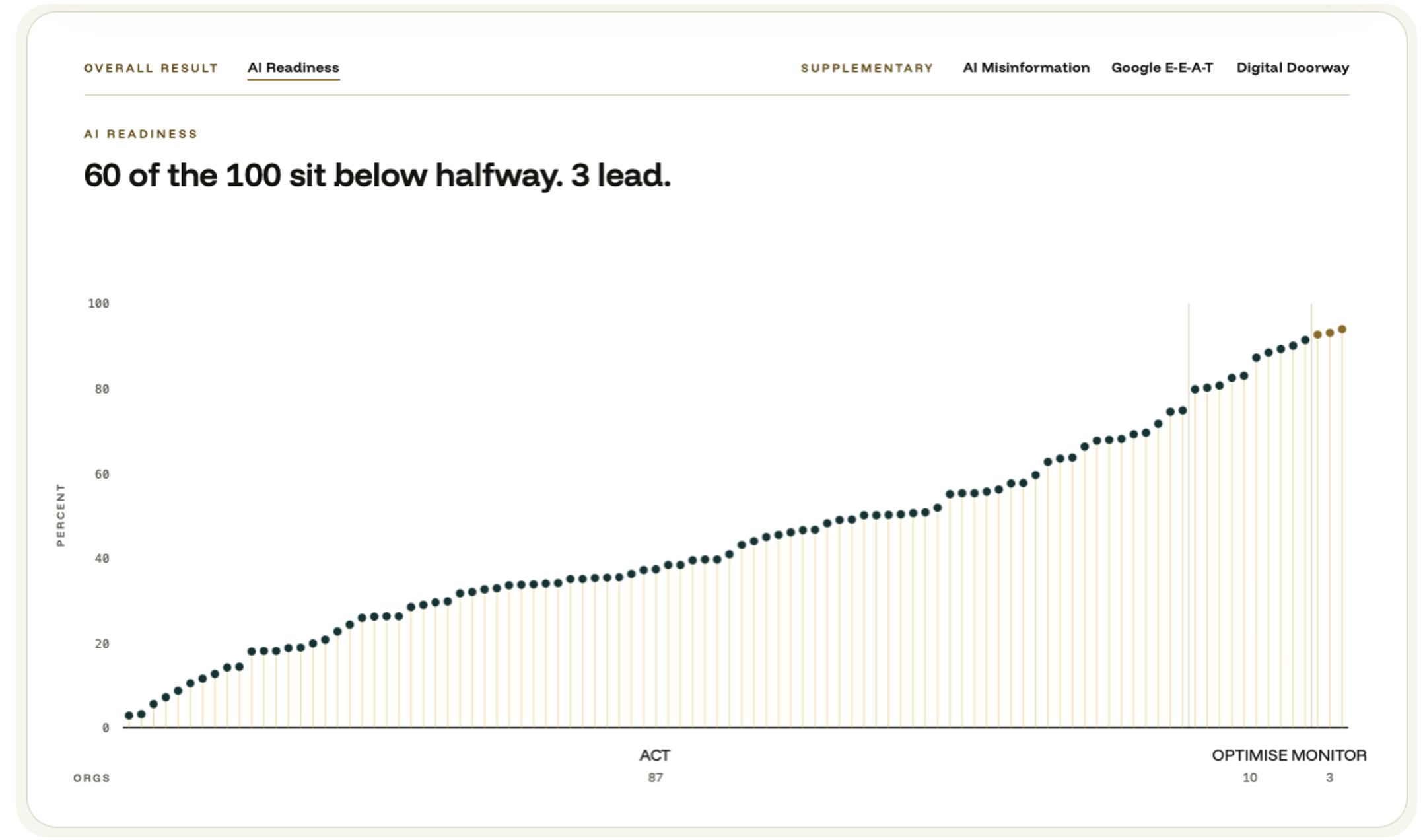 Dot-and-line chart showing percentage across organisations, with labels ACT 87 and OPTIMISE 10, MONITOR 3 along the horizontal axis. Teal markers and pale gold vertical guides indicate a steady rise from near 0% to approximately 95%, with faster growth towards the final organisations. Headline: 60 of the 100 sit below halfway, 3 lead.
Regulatory and insurance practice also emphasises evidence of oversight. EIOPA’s opinion addresses accountability, audit responsibilities and continuing monitoring of insurers’ own AI use. Munich Re examines data sources, performance monitoring and responses to deteriorating AI performance when assessing insurability and pricing. These provide specific examples of the evidence considered by supervisors and underwriters.
For management, revisions remain traceable, with historic statements recognisable as history and unresolved contradictions assigned for further action. Reporting distinguishes publication of a correction from evidence that the identified discrepancy has been resolved. The record explains which earlier statements remain accessible and how they are distinguished from the company’s revised guidance.
Reporting on the AI Readiness Maturity Scale™ presents the board with an evidenced assessment, explains changes since the previous review and identifies outstanding decisions. The Scale provides a framework for understanding, comparing and tracking that position. Independent monitoring demonstrates whether management’s interventions have addressed the findings.
AAAnow’s AI Accelerator offers a practical route into this work through a 6-week programme examining the information foundations for AI, with client-led improvement, weekly review and maturity reporting. For leadership, the continuing requirement is evidence that company information accurately reflects the business and that corrective action remains effective as reliance on AI develops.
The version of the organisation investors encounter through AI deserves the same care as the information published in its name.
10 Questions for leadership.
How extensively do institutional and private investors use AI?
The CAQ study found 68% of qualified US institutional respondents using AI extensively or moderately in investment research and decision-making. HSBC reported 73% usage for finance and investment among affluent and wealthy investors across ten markets. Separately, eToro found 19% of surveyed retail investors using AI to select or change investments. These measures cover different activities and respondent groups.
Which investment activities are investors using AI to support?
Institutional applications include screening investments, analysing company filings and earnings calls, financial modelling and risk assessment. Private investors consult AI for research, strategic guidance and second opinions. These uses contribute to the information considered during investment assessment.
How can inaccurate information discourage an investor from proceeding?
Inaccurate information can distort the assessment of a company’s performance or prospects. AAAnow’s superseded-guidance scenario illustrates an investor anticipating performance below an outdated forecast; its acquisition scenario describes conflicting records affecting the buyer’s negotiating position. The original source also receives limited attention in some search settings: Pew observed fewer conventional-result clicks when Google displayed AI summaries, although its study concerned general search behaviour.
What do information discrepancies reveal about governance?
They identify matters requiring examination, including responsibility for published information and the effectiveness of review and correction. Unexplained conflicts raise questions about management’s knowledge of its own public record. When a known discrepancy recurs, the board examines why the earlier response proved insufficient and what evidence supports the proposed correction.
How does this relate to efficiency, scale and competitive advantage?
McKinsey’s research records expansion in AI deployment, improved personal productivity and reported competitive differentiation. Organisations pursuing these benefits have reason to examine the reliability of the information supporting their AI programmes. Independent assessment and continuing monitoring provide evidence for that examination, including unresolved discrepancies and the results of corrective action. Leadership can use those findings to determine what requires improvement as the organisation expands its reliance on AI.
What should management establish when company information changes?
Management maintains a traceable account of the revision, identifies conflicting statements and distinguishes historic guidance from the approved position. Finance verifies financial meaning, with technology and investor communications addressing publication and consistent explanations. Subsequent assessment establishes whether the revised information is being recovered accurately.
What does independent audit and monitoring contribute to board oversight?
Independent examination provides the board with evidence beyond management’s account of its own publishing activity. Continuing monitoring examines changes and the results of corrective action, so the board can assess progress against documented findings. EY’s research supplies relevant investor context: respondents said external assurance would increase their confidence in nonfinancial reporting. Boards reporting under the UK Code determine the extent of external assurance they require.
What should reporting on the AI Readiness Maturity Scale™ present to the board?
Reporting presents the assessed position, explains changes since the preceding review and identifies unresolved findings requiring management or board decisions. The supporting evidence remains available for independent examination. The Scale provides a framework for understanding, comparing and tracking the position over time.
What evidence of AI oversight do regulators and insurers expect?
Requirements depend on the activity and framework concerned. ESMA places responsibility with management bodies for AI-related decisions within the investment services it covers. EIOPA addresses controls, audit and monitoring of insurers’ own AI use. Munich Re examines performance evidence and corrective arrangements when assessing AI insurance. Under the UK Code, Provision 29 addresses board monitoring and reporting, while boards determine the extent of external assurance required.
What should leadership establish before expanding reliance on AI?
Leadership needs to know which information supports existing and planned AI activity, and what the readiness assessment has established about it. Significant discrepancies require an identified owner and a documented response. Independent monitoring and subsequent board reporting demonstrate which findings have been resolved and which still require decisions before further reliance on the affected information.
Sources.
Surveys, regulatory material and the AAAnow findings and scenarios drawn on in this article. Addresses are shown for reference.
- Center for Audit Quality and KRC Research · Institutional Investor Survey: AI UseJul. 2026 · 101 US institutional respondents; fieldwork 8–19 May 2026. Director level or above, over five years’ experience, firms with at least US$500 million under management. Research use, decision roles and expected adoption. https://thecaq.wpenginepowered.com/wp-content/uploads/2026/07/caq_institutional-investor-survey-ai_2026-07.pdf
- HSBC and Ipsos · The Trust Threshold24 Jun. 2026 · 9,993 affluent and high-net-worth investors, aged 21–69, across ten markets; fieldwork 6 Jan.–6 Feb. 2026. Finance and investment use, ideas and research activities. https://www.hsbc.com/news-and-views/news/media-releases/2026/the-trust-threshold-ai-makes-investors-bolder-but-they-want-human-judgement-to-make-decisions
- eToro and Opinium · Retail investors flock to AI tools, with usage up 46% in one year1 Oct. 2025 · 11,000 retail investors across 13 countries; fieldwork 5–19 Aug. 2025. Reported use of AI to select or change investments. https://www.etoro.com/news-and-analysis/etoro-updates/retail-investors-flock-to-ai-tools-with-usage-up-46-in-one-year/
- Janus Henderson Investors · Investor Survey 20262026 · 1,000 US investors aged 25 or older with at least US$250,000 in investable assets. Experimental forecasts and investor expectations; responsibility finding among respondents using or planning to use an adviser. https://www.janushenderson.com/download/document/16790
- PwC · Global Investor Survey 20252025 · 1,074 investment professionals across 26 countries and territories; fieldwork 1 Sep.–6 Oct. 2025. Reliance on disclosures and expectations of information about company AI governance. https://www.pwc.com/gx/en/issues/c-suite-insights/global-investor-survey.html
- Financial Reporting Council · Structured Digital Reporting: Insights 2025/2620 May 2026 · Detailed review of 30 UK listed companies’ digital annual reports, with wider market analysis. Observed classification, scaling, availability and validation problems; structured-reporting scope. https://www.frc.org.uk/library/digital-reporting/structured-digital-reporting-insights-202526/
- Listed-company use casesAccessed 15 Sep. 2026 · Collection containing the observed annual-report review findings and the illustrative company scenarios discussed in the article. https://aaanow.ai/use-cases/listed-companies/index.html
- The annual report AI read was not the one the board signedAccessed 15 Sep. 2026 · Observed findings from anonymised annual-report reviews, including the loss of financial meaning when tables and headings are interpreted by machines. https://aaanow.ai/use-cases/annual-report-not-the-one-signed/index.html
- Investors were quoted guidance the company had already revisedAccessed 15 Sep. 2026 · Illustrative scenario: Jan. guidance remains available after a Jul. revision, causing investors to assess the company against a superseded forecast. https://aaanow.ai/use-cases/guidance-already-revised/index.html
- Investor updates lost in templatesAccessed 15 Sep. 2026 · Illustrative scenario: newly published information is obscured by templates or PDFs while AI continues returning an older figure. https://aaanow.ai/use-cases/investor-updates-lost/index.html
- AI quoted a hostile version of the resultsAccessed 15 Sep. 2026 · Illustrative scenario: an external account with altered figures displaces inaccessible company results in AI answers. https://aaanow.ai/use-cases/hostile-version-of-the-results/index.html
- The buyer’s AI knew things about the company that the company did notAccessed 15 Sep. 2026 · Illustrative acquisition scenario: conflicting public records weaken the seller’s negotiating position and expose gaps in management’s knowledge. https://aaanow.ai/use-cases/buyers-ai-knew-more-than-the-company/index.html
- AAAnow · Imtiaz Kaderbhoy · Correct to people, wrong to machines3 Jun. 2026 · Analysis of financial meaning, published company information and leadership responsibility across finance, technology and communications. https://aaanow.ai/articles/correct-to-people-wrong-to-machines/index.html
- McKinsey · The state of AI in 2026: On the road to ROI25 Aug. 2026 · 1,719 respondents across 97 countries; fieldwork 4 May–8 Jun. 2026, weighted by national GDP. Organisational scaling, individual productivity, investment expectations and reported competitive differentiation. https://www.mckinsey.com/capabilities/quantumblack/our-insights/the-state-of-ai
- EY · How can CFOs be confident in value creation without confidence in reporting?23 Oct. 2024 · 2,000 finance leaders and 815 institutional investors; FT Longitude fieldwork Mar.–May 2024. Investor expectations of external assurance for nonfinancial reporting. https://www.ey.com/en_us/insights/financial-accounting-advisory-services/corporate-reporting-survey
- Financial Reporting Council · UK Corporate Governance Code 202422 Jan. 2024; application checked Sep. 2026 · Comply-or-explain regime for commercial-company and closed-ended investment-fund listing categories. Provision 29 applies to financial years beginning on or after 1 Jan. 2026. Board discretion over external assurance. https://www.frc.org.uk/library/standards-codes-policy/corporate-governance/uk-corporate-governance-code/
- EIOPA · Opinion on Artificial Intelligence governance and risk management6 Aug. 2025 · Supervisory opinion concerning insurers’ and intermediaries’ own AI use within its stated scope. Paragraphs 3.29–3.36 cover controls, audit, accountability and ongoing monitoring. https://www.eiopa.europa.eu/publications/opinion-artificial-intelligence-governance-and-risk-management_en
- Munich Re · De-Risking AI VenturesAccessed 15 Sep. 2026 · Pages 4–7 describe AI insurance due diligence, including data, performance monitoring, quality management and corrective responses, informing insurability and pricing. https://www.munichre.com/content/dam/munichre/contentlounge/website-pieces/documents/MunichRe-De-Risking-AI-Ventures-Whitepaper.pdf
- AAAnow · AI Readiness Maturity Scale™Updated 3 Sep. 2026 · Published framework for understanding, comparing and tracking the underlying AI readiness position over time. https://aaanow.ai/platform/maturity-scale/
- AAAnow · AI AcceleratorUpdated 2 Sep. 2026 · 6-week programme examining AI information foundations, with client-led improvement, weekly review and maturity reporting. https://aaanow.ai/service/ai-accelerator/
- Pew Research Center · Google users are less likely to click on links when an AI summary appears in the results22 Jul. 2025 · Browsing records from 900 US adults and 68,879 Google searches in Mar. 2025; corresponding results collected in Apr. General search behaviour, rather than an investor sample. https://www.pewresearch.org/short-reads/2025/07/22/google-users-are-less-likely-to-click-on-links-when-an-ai-summary-appears-in-the-results/
- ESMA · Public statement on AI in retail investment services30 May 2024 · Investment firms and credit institutions providing MiFID II investment services. Management responsibility, oversight, input information, records and checks on AI-supported services. https://www.esma.europa.eu/sites/default/files/2024-05/ESMA35-335435667-5924__Public_Statement_on_AI_and_investment_services.pdf