Organisations are investing heavily in their brands, digital estates, investor communications and AI strategies. Yet the assessments examined here show that AI-related access routes can be unable to reach the authoritative information those investments have created, even when the public website appears fully operational.
Their websites can appear completely operational to people and conventional search while some AI-related routes are turned away or receive no reply. Restricting an access route does not prevent AI discussing the organisation. It can reduce the opportunity for the organisation's current, controlled information to shape the answer.
The consequence is amplified because AirOps research found that 85% of brand mentions came from third-party pages rather than owned domains.[1] Meanwhile, Sitemorse surveys conducted in 2021, 2023 and 2025 found that 92% of digital leaders recognised the unmapped landscape and uncontrolled PDFs as a top-3 challenge.[2]
AI Readiness is therefore an essential operating foundation. It requires organisations to establish their Foundations, apply Governance and maintain Visibility across the information AI can access, interpret and use. AAAnow has examined organisations from the outside in for more than 25 years and has trained its AI using more than 3.7 trillion data points.[4] That experience now supports a practical way to identify where authoritative information is unavailable through tested routes, where content communicates incorrectly to machines, and where organisational conditions are likely to create misinformation.
This is not simply a search, website or technical problem. It can affect brand authority, future visibility, regulatory exposure and the value returned from existing digital investment. Within this article, digital suicide describes a self-inflicted surrender of influence. The organisation remains visibly online while weakening the opportunity for its authoritative voice to shape AI-generated answers.
01Being online no longer guarantees being available.
Not appearing on Google would be inconceivable for any serious organisation. The assessments examined here show that an equivalent condition can occur across AI-related access routes without being visible through ordinary website checks.
The public website still loads, the navigation still works, and the content remains available to ordinary visitors. Conventional search may continue indexing the website without interruption. Everything therefore appears normal when judged through the digital measures leadership teams have relied upon for years.
AI-related routes supporting discovery, comparison, recommendation and other functions can encounter a completely different digital front door. Some receive the page, some face a challenge, and others receive no reply.
Digital suicide does not mean immediately disappearing from the internet. It means deliberately or inadvertently reducing the opportunity for the organisation's authoritative voice to influence systems increasingly shaping how that organisation is found, understood, compared and represented.
02What the outside-in assessment reveals.
AAAnow assesses the digital doorway from the same outside-in position experienced by customers, search technologies and AI services. A scheduled team of up to 24 agents uses different technologies and access routes to establish what people receive and whether leading AI-related routes can reach the organisation's public information.
Those 24 agents perform 1 defined task: they reveal and organise the organisation's visibility to AI at the digital doorway. They do not represent the complete AI Readiness capability; their purpose is to make a complex access condition visible without requiring executives to interpret protocols, response codes or crawler classifications.
The leadership question remains straightforward: can the AI-related routes assessed reach the information the organisation considers current and authoritative? The 5 anonymised assessments below demonstrate why checking the ordinary website experience cannot answer that question.[3]
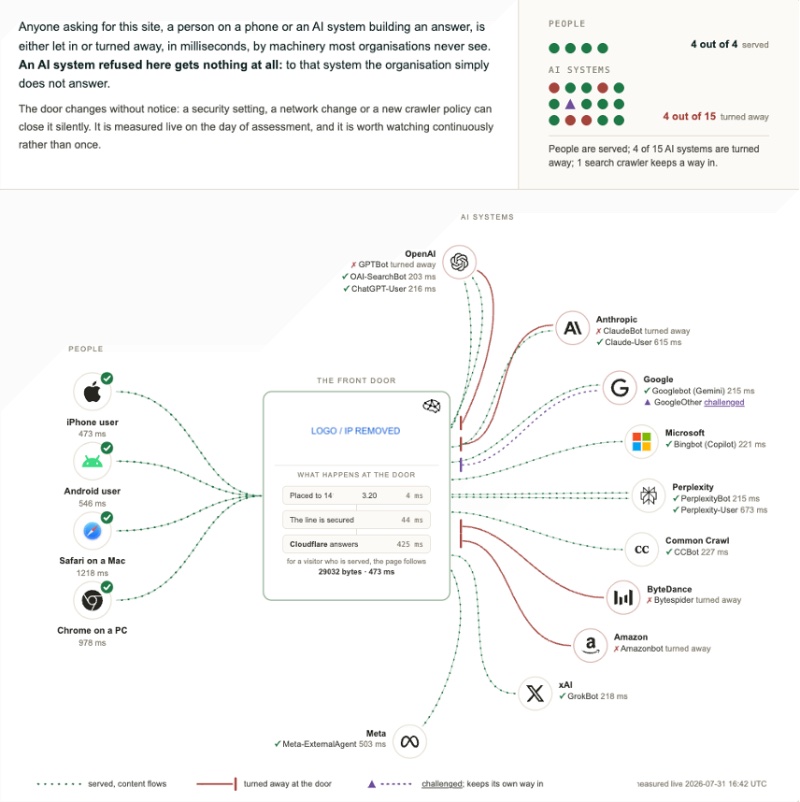
03Example 1: selective restriction behind a healthy website.
All 4 tested routes used by people were served. 4 of the 15 tested AI-related routes were turned away, while one search crawler was challenged but retained a route into the site.
The organisation appeared fully available through all tested human routes, while the access results varied across the machine routes approaching the same digital doorway.
04Example 2: widespread refusal across tested AI-related routes.
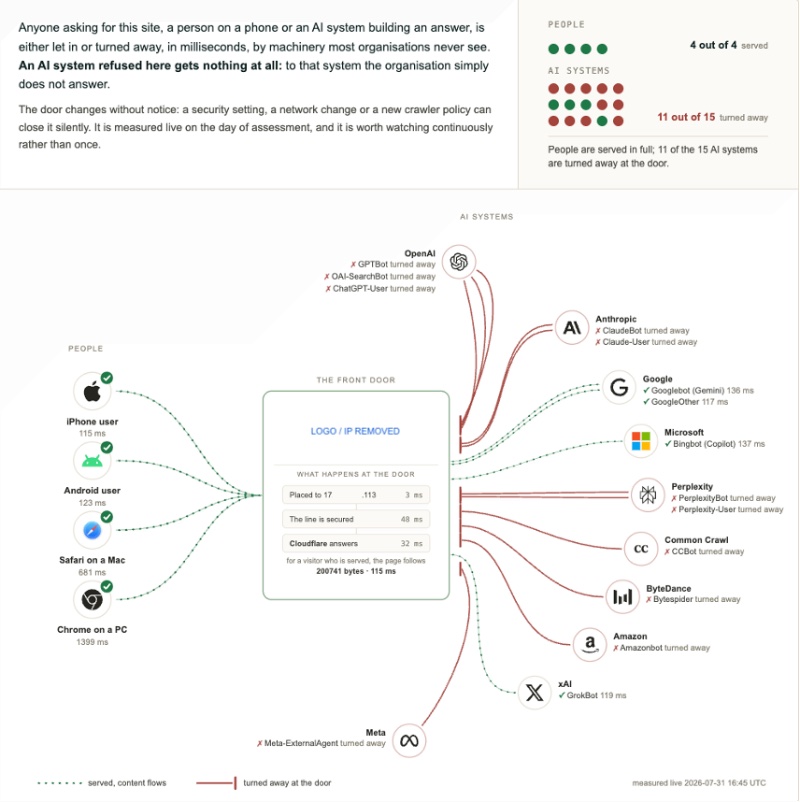
All 4 tested routes used by people were served, while 11 of the 15 tested AI-related routes were turned away.
The organisation remained visibly online for customers and employees, but most tested AI-related routes were turned away from the authoritative source intended to explain its current position.
05Example 3: no reply across 14 AI-related routes.
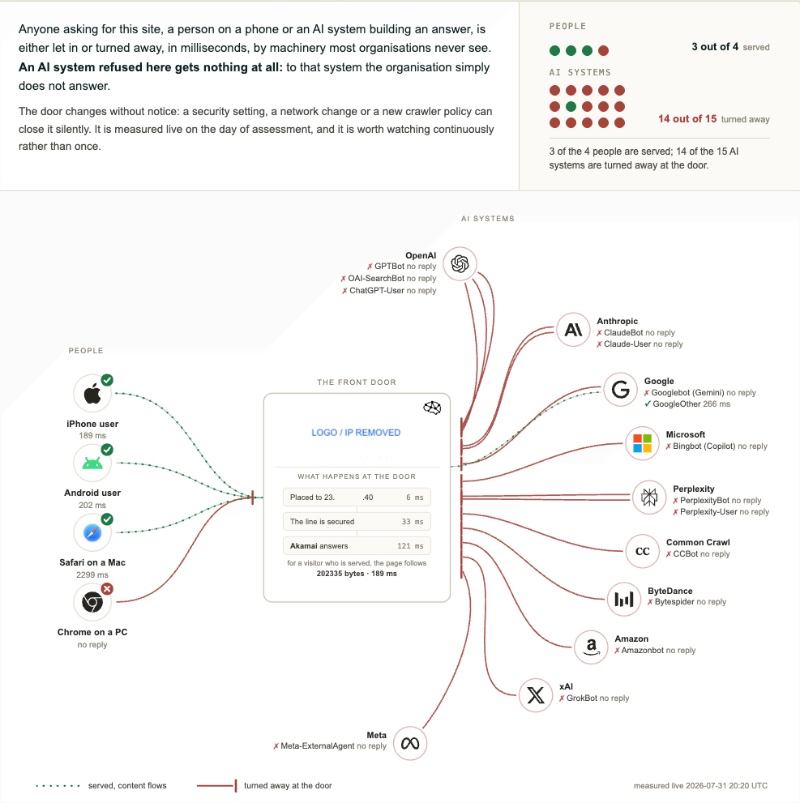
3 of the 4 tested routes used by people were served. 14 of the 15 tested AI-related routes received no reply, while GoogleOther was served.
This records no reply across 14 of the 15 AI-related routes assessed, although the organisation remained sufficiently available to appear operational through most ordinary checks. The wording records the observed outcome without assigning an intention or technical cause.
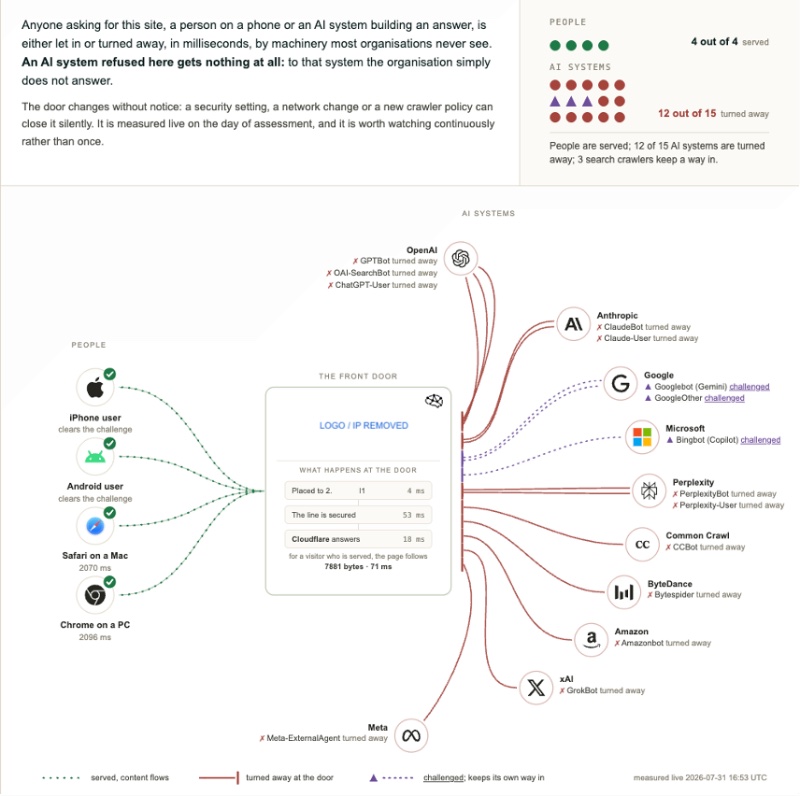
06Example 4: retained Google and Microsoft routes amid wider refusal.
All 4 tested routes used by people were served. 12 of the 15 tested AI-related routes were turned away, while 3 Google and Microsoft routes were challenged but retained routes into the site.
Those 3 retained routes did not establish equivalent availability across the 12 other AI-related routes assessed.
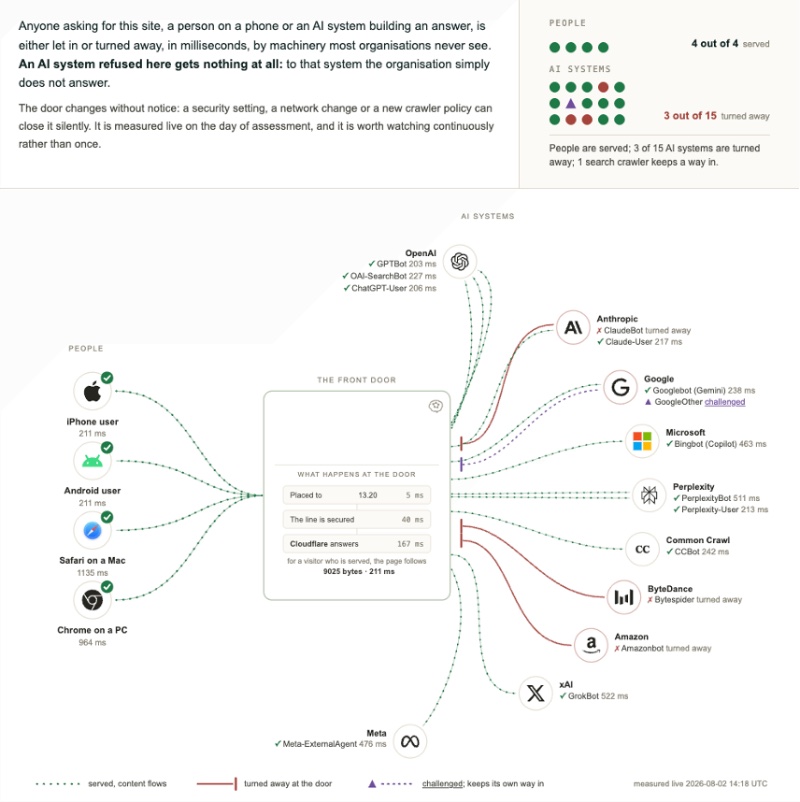
07Example 5: a more open but still uneven position.
All 4 tested routes used by people were served. 3 of the 15 tested AI-related routes were turned away, while one Google route was challenged but retained a route into the site.
This position is more open than the preceding examples, but it remains uneven. A successful result across one human or machine route cannot represent all routes attempting to reach the organisation's information.
08Denied access does not create silence.
Restricting an AI-related route does not necessarily stop an AI service discussing the organisation. It can instead reduce the opportunity for the organisation's current information to influence what that service says.
AI services can still encounter historic pages, third-party commentary, media coverage, directories, archived documents and information repeated elsewhere. When the authoritative source is unavailable through a relevant route, those alternatives can acquire greater influence over the resulting answer.
That matters because AirOps research found that 85% of brand mentions came from third-party pages rather than owned domains.[1] Where access to current organisational content is restricted, that finding increases the importance of understanding the third-party information already surrounding the brand.
The problem is compounded by the digital estate itself. Sitemorse surveys conducted in 2021, 2023 and 2025 found that 92% of digital leaders recognised the unmapped landscape and uncontrolled PDFs as a top-3 challenge.[2] An organisation may therefore restrict access to current material while forgotten pages, old documents, campaign sites and third-party sources remain available.
This is where misinformation and misrepresentation begin to converge. Misinformation is information that is inaccurate, incomplete, outdated or contextually wrong. Misrepresentation is the resulting portrayal of the organisation, its products, services, policies, performance or position. When authoritative information is absent, a series of individually plausible sources can still combine into a materially inaccurate organisational picture.
One credible commercial consequence is brand dilution. The organisation has funded the brand, created the content and published the current position, but restricted access can leave older or uncontrolled material with a greater opportunity to influence AI-generated answers.
09When 1 search produces 2 organisational truths.
The practical consequence can appear within a single search-results page. Google Gemini presents an AI-generated answer first, while the organisation's current organic result appears immediately below it. The 2 outputs provide conflicting information about the same organisation.
Conventional Google search reached the current organisational page through one route, while the corresponding Gemini-related route did not receive equivalent access during the assessment. That access difference can leave older, indirect or third-party information with a greater opportunity to influence the AI-generated answer shown first.
The organisation was not excluded from the discussion. Its current information appeared directly below, but the restricted route reduced its opportunity to influence the first AI-generated answer.
10When a polished annual report creates regulatory exposure.
Access is only the first requirement because machine interpretation determines what AI can extract and repeat. A public company can publish an annual report that appears impressive and correct to human readers while communicating its underlying information incorrectly to machines.
Tables can become misaligned, figures can separate from headings, fonts can fail, and information can be extracted in the wrong sequence. An AI system may then report financial information incorrectly because the organisation's own source document supplied that information through a defective structure.
The resulting exposure is not merely presentational. When incorrect source structure causes AI to report published financial information inaccurately, the organisation has created a credible regulatory exposure through material it released as authoritative.
Blaming the AI output alone misses the originating failure in this example. The misinformation appears within the AI answer, but the defective structure was published by the organisation itself.
11Why this belongs within executive leadership.
For chief executives, the issue concerns whether the organisation retains authority over how customers, investors, employees, regulators and commercial partners understand it. Brand investment can be weakened when current organisational information has less opportunity to influence the systems increasingly framing that understanding.
For chief financial officers, the issue concerns whether investment in content, digital infrastructure, investor communications and AI visibility can produce value when authoritative information remains inaccessible or structurally unreliable. The value of further visibility investment deserves scrutiny until the organisation establishes whether AI-related routes can reach and correctly interpret the material being promoted.
For boards, the issue crosses security, infrastructure, digital, communications, investor relations, governance and risk. Responsible restrictions may be necessary, but each restriction should be known, intentional, owned and understood alongside its information consequence.
Within Governance, AAAnow is starting to automate selected measures relevant to the EU AI Act while tracking regulatory developments across the United States.[4] This places changing obligations alongside the organisation's access, content and monitoring evidence, where executive ownership can be made visible.
Executive leadership should now answer 6 direct questions
- Do we know what leading AI systems can access and receive?
- Who owns each decision that serves, challenges or refuses access?
- Are current restrictions intentional, documented and understood across leadership?
- Which pages and documents remain current, authoritative and machine-readable?
- How continuously are access, interpretation and representation conditions monitored?
- Who is accountable when organisational conditions create misinformation or misrepresentation?
12AI Readiness provides the operating foundation.
The digital doorway is the beginning of AI Readiness, not its complete measure. Foundations establish what exists across the estate and whether its content can be reached and understood. Governance establishes ownership, controls and evidence, while Visibility monitors how AI systems encounter and represent the organisation as those conditions change.
AAAnow has built a management team of 187 agents capable of performing more than 360,000 verifications across that operating model.[4] Their value lies not in the number itself, but in the practical shortcut created by proven automation.
For an organisation choosing to recreate that capability internally, the requirement would include time, specialist knowledge and continuing infrastructure to understand how different AI services access and interpret different content, then repeat the work as technology, policy and regulation change. AAAnow's automated capability instead organises where the organisation stands, where likely misinformation can originate, and where executive attention is required.
2 immediate use cases show why this foundation matters. Brand dilution can occur when inaccessible authoritative information leaves historical, conflicting or third-party sources with greater influence over how the organisation is represented. Regulatory exposure can arise when defective organisational content, including incorrectly structured financial documents, causes AI systems to extract and report material information inaccurately.
Both outcomes can surface as AI misinformation or misrepresentation. Both can begin with conditions created by the organisation itself.
The choice behind digital suicide.
AI systems can continue forming answers about organisations when relevant access routes are restricted. Restricting a route does not necessarily remove the organisation from that discussion. It can reduce the opportunity for current and authoritative organisational information to shape the discussion.
AI Readiness gives leadership a way to identify, govern and monitor those conditions before investing further in visibility alone. It does not require unrestricted access for all machines. It requires deliberate control over what is accessible, what is authoritative, how machines interpret it, and who remains accountable for the outcome.
The decision is not whether AI can discuss the organisation. The decision is whether current, authoritative organisational information will be available to shape that discussion. Where restricted access, an unmapped estate and incorrectly structured content combine, the organisation risks surrendering authority through its own operating conditions.
That self-inflicted surrender is what this article means by digital suicide.
Sources.
- AirOps research. Reported that 85% of brand mentions came from third-party pages rather than owned domains. airops.com/blog/llm-brand-citation-tracking (opens in a new tab)
- Sitemorse surveys, 2021, 2023 and 2025. Recorded the unmapped landscape and uncontrolled PDFs as a top-3 recognised challenge among digital leaders. sitemorse.com (opens in a new tab)
- AAAnow outside-in assessments. The 5 access examples are anonymised AAAnow outside-in assessments; the screenshots were supplied for this article.
- AAAnow operating claims. The 25-year outside-in history, AI training across more than 3.7 trillion data points, the 24-agent doorway assessment, the 187-agent management capability, capacity for more than 360,000 verifications and proven automation are AAAnow operating claims supported by internal platform records. AAAnow also reports active development work to automate selected measures relevant to the EU AI Act and to track regulatory developments across the United States.