
Most AI governance work looks inward: which tools to buy, which models to train, how colleagues should use them. That work matters, and it is half the job. While the board settles the internal question, the public-facing systems, SGE, Perplexity and OpenAI among them, are already describing the organisation to anyone who asks, from whatever they happen to find.
What follows is the shape of that outside-in exposure, what the 2026 benchmarking data says about how ready organisations are for it, and what a fixed 6 weeks of work does about it.
01The new information paradigm:
understanding outside-in risk.
AI governance has historically taken an inside-out view, prioritising internal tool selection, model training and employee implementation. The shift now needed runs the other way. The content environment available to external AI agents usually sits beyond an organisation’s direct control, and what those systems find and interpret becomes the definitive narrative of the organisation, whatever the intent inside it. Boards concentrate on their own LLMs while the public-facing environment defines the brand from dirty data found outside.
3 systemic vulnerabilities make up the threat landscape as it stands.
The outside-in threat landscape · 3 vulnerabilities, 1 outcome
Generative systems ingest fragmented or conflicting data and produce false narratives that sound authoritative.
Obsolete campaign sites, historic pages and unindexed PDFs, sitting there as a reservoir of misinformation.
External information deliberately manipulated to distort how AI models perceive the organisation.
What the systems find and interpret becomes the story of the organisation, whatever the intent inside it.
Digital Debt is the one that surprises people. AAAnow research indicates that PDF content carries up to a 1.8x authority factor in AI interpretation, so a document nobody has looked at for years can outweigh the current HTML page written to replace it. The old answer wins because the machine trusts the older file more.
AAAnow research, PDF authority factor in AI interpretation.
85% of brand mentions within commercial AI discovery originate from external domains. An organisation’s preferred narrative is often secondary to the vast, unmanaged external content environment that AI prioritises today.
AirOps, commercial AI discovery researchAirOps, commercial AI discovery researchWe do not enable external links - please copy and paste, you are then certain as to the link being opened
That volatility is the argument for moving off the back foot. A reactive posture answers each wrong description as it appears; a benchmarked understanding of the risk profile, measured on the AI Readiness Maturity Scale™, tells you where you stand before the next one does.
02Market realities:
the 2026 AI risk benchmarking report.
Corporate sentiment in 2026 has moved from speculative hype to a grounded focus on operational liability. Productivity gains are rising, and organisations are also discovering that the value of AI deployment takes an average of 28 months to outweigh upfront costs. Foundational failures in risk management widen that gap.
The Gallagher 2026 benchmarking survey sets out the governance gap in 4 lines.
| Metric | Percentage |
|---|---|
| Businesses viewing AI errors, misinformation, and hallucinations as a top risk | 57% |
| Businesses identifying legal and reputational risks as a primary concern | 56% |
| Businesses lacking formal AI risk management or governance frameworks | Over 50% |
| Businesses with a implemented AI-specific incident response plan | 43% |
Gallagher, AI Adoption and Risk Benchmarking survey, 2026.
Read together, those 4 lines describe a dangerous exposure. Nearly 60% of leadership identifies misinformation and reputational damage as a primary threat, and more than half are operating without a formal framework to mitigate it. That leaves organisations open to a black box of algorithmic risk, where the traditional breach response does not apply. Set against the 28-month average for AI return, a structured, time-bound intervention becomes the practical way to protect both the investment and the reputation.
03The 6-week AI Accelerator:
strategic mitigation framework.
AI Accelerator takes an organisation from understanding to practical action inside a fixed 6 weeks. The philosophy is surgical: identify the information foundations driving AI interpretation, and address them before they turn into liability.
5 pillars carry the framework.
Proprietary AI Misinformation Exposure mapping. Proprietary methodology identifies precisely where organisational data is being missed or misinterpreted, and names the misinformation hotspots that need attention first.
Systemic Digital Debt remediation. A rigorous clean-up of obsolete content across a benchmarked landscape of up to 100 key websites, so AI stops surfacing dead information.
Authority transformation, PDF to HTML. The 80/20 principle applies here, with 80% of consumption driven by just 4 to 6% of content, so high-value PDFs are processed intelligently and converted into machine-readable HTML. AI interpretation then matches human intent, and the 1.8x authority risk carried by outdated documents is neutralised.
Technical control implementation, Secure Tag. Schema protocols, robots controls and access signals establish a verified content signal for AI bots: a secure technical doorway for authoritative information.
Cross-functional ownership workshops. Strategic sessions that bring Governance, Risk and Communications stakeholders into the same room, moving AI out of the technical silo and into the strategic core.
Together they turn a fragmented digital presence into a controlled environment. AAAnow provides the evidence and the guidance; the client implements the changes that keep the position technically and legally accurate.
04Operationalising governance:
from infrastructure to interpretation.
AI liabilities are not simple data breaches. They are a multidisciplinary risk, and they need legal, risk and communications people looking at them together. AI models are in a constant state of update, so governance cannot stand still either.
Verify. Authoritative sources are confirmed through Secure Tag protocols, so AI agents prioritise official organisational signals.
Process intelligently. Prioritised content is handled so that the machine-readable version keeps the context of the human-readable original.
Audit the Digital Doorway at scale. The Accelerator uses 207 bots performing up to 360,000 reviews, so the outside-in visibility is secure and accurate.
A person stays in the loop throughout. Organisations commit to re-evaluating these controls each time an AI model is updated or new code is written, because either shift can lead a system astray. That oversight is what keeps the information infrastructure aligned with what the organisation actually intends.
Controls need something to be measured against, which is where the monitoring position comes in. Once the outside-in view is established, it is held on the AI Readiness Maturity Scale™ and watched as it moves, so a change in the position is seen rather than discovered later.
That position can be held 2 ways. Benchmarked against your sector, it shows where you stand beside the organisations you are compared with, on the same measure, run the same way. Held privately across your own landscape, it does the same job internally: each site, division or market measured against the others, with the movement tracked over time and nothing published outside.
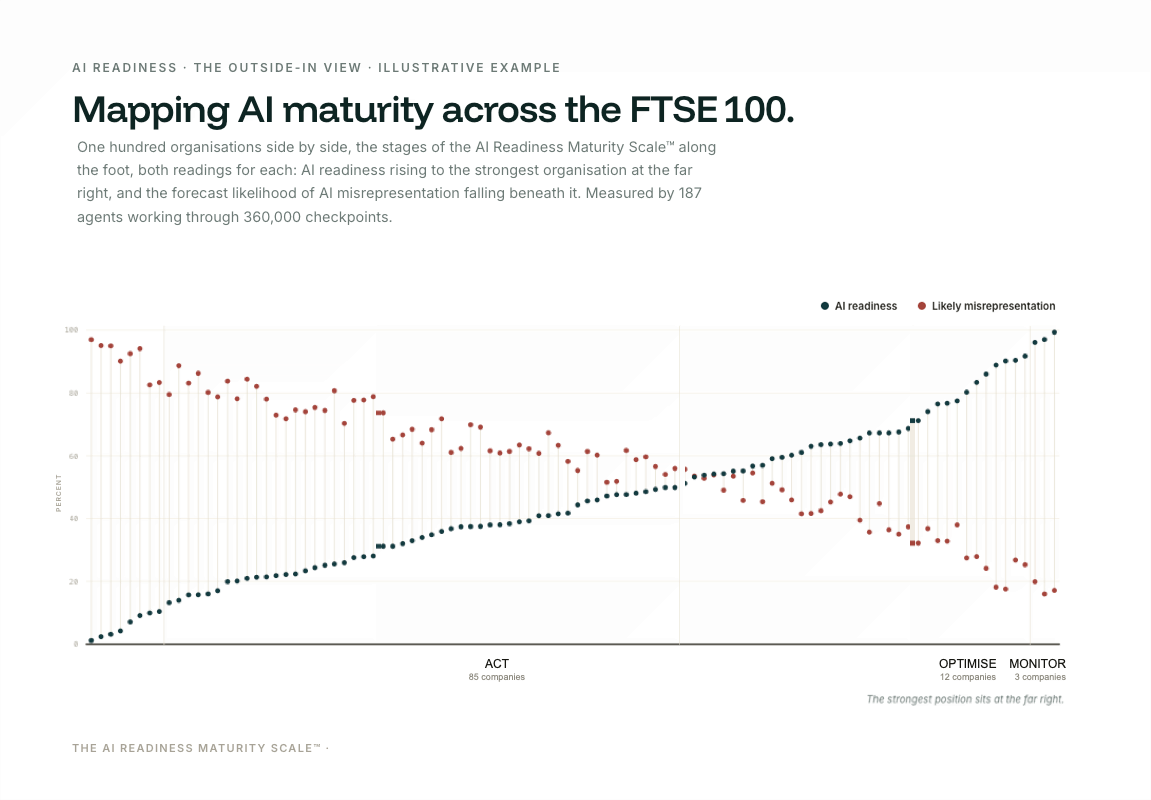 Illustrative example chart titled Mapping AI maturity across the FTSE 100. One hundred organisations side by side, the stages of the AI Readiness Maturity Scale along the foot, both readings for each: AI readiness rising to the strongest organisation at the far right, and the forecast likelihood of AI misrepresentation falling beneath it. Dark teal dots for AI readiness climb from near 0 at the left to near 100 at the right; red dots for likely misrepresentation fall from the high 90s to under 20, crossing the readiness line in the ACT stage. Stage counts along the foot: ACT 85 companies, OPTIMISE 12, MONITOR 3.
Read either way, the chart answers the question a board actually asks: not whether the work was done, but whether the position has improved, and by how much.
05Implementation roadmap
and commercial summary.
The 6-week AI Accelerator is a fixed-duration engagement built for rapid mobilisation. It asks for cross-functional participation, because that is what makes the resulting AI Readiness Maturity Scale™ position accurate and worth acting on.
| Commercial terms | The final position |
|---|---|
| Total investment | £24,500. |
| Duration | Fixed 6-week period. |
| Primary deliverables | An improved primary website position, implemented by the client, a benchmarked landscape of 100+ sites, and a structured AI-project dependency framework. |
Historical data shows that 90% of AI projects fail. Those failures are rarely the technology’s doing; they are the result of weak information foundations. Remediating Digital Debt and establishing a controlled outside-in presence puts the foundations under the work, which is what reduces the failure rate and protects the AI investment.
AI Confidence begins with mastering the content environment you inhabit today. Control how you are found and interpreted, and your digital legacy informs your future rather than undermining it.